

Bicycle Racing News and Opinion,
Friday, October 30, 2026
Back to news and opinion index page for links to archived stories | Commentary | Our YouTube page
When they call the roll in the Senate, the Senators do not know whether to answer 'Present' or 'Not guilty.' - Theodore Roosevelt

Plato's dialogue Apology is available in both Kindle eBook & audiobook versions. To get your copy, just click on the Amazon link on the right.
Upcoming racing:
- Nov 1: Trofee Oudenaarde - Koppenbergcross
- Nov 7 & 8 European Cyclocross Championships
- Nov 15: Flandriencross
- Dec 6: Superpresitge Ruddervoorde
- Dec 19: Scheldecross
- Dec 23: Azencross-Loenhout
- Dec 25: Heusden Zolder Cross
- Dec 26: Gavere Cyclocross
- Dec 27: Namur Cross
- Dec 30: Diegem Cyclocross
- Jan 1: GP Sven Nys
- Jan 16 - 24: Tour Down Under
Latest completed racing:
- Oct 25: Superpresitge Overijse - Vlamse Druivencross
- Oct 13 - 18: Tour of Guangxi
- Oct 13 - 18: Tour of Holland
- Oct 18: Chrono des Nations
- Oct 18: Veneto Classic
- Oct 18: Japan Cup road Race
- Oct 14: Giro del Veneto
- Oct 11: Paris-Tours
- Oct 10: Il Lombardia
- Oct 8: Gran Piemonte
The rest of the year's completed races are here.








Content continues below the ads

Peeters’ Team Soudal Quick- Step posted this:
Ask Wilfried Peeters what he enjoys most about being a sports director and his answer comes quickly: working with young people.
After almost a quarter of a century in the team car, he has accumulated an enormous amount of knowledge about professional cycling. Yet what keeps him motivated is the opportunity to put that experience to use, explaining a position to a rider, seeing it happen during a race, and watching that rider understand how to approach the situation next time. For ‘Fitte’ as he is known around the team, there is particular satisfaction in winning a race through good decision making.
“Winning is always the goal, but I’m especially proud when we win with a rider who wasn’t necessarily the strongest that day,” he explains. “You can make the difference tactically, by giving the right information. Sometimes it’s a small thing, like explaining how to approach a climb next time. When those things work, that gives me a very good feeling.”

Wilfried Peeters at a 2014 Tour de France press conference. Sirotti photo
Those small lessons are an important part of his work. A rider’s development is measured in results, but the progress that produces them often happens elsewhere: in a conversation after a difficult stage, a better decision before a climb, or a clearer understanding of when to use their energy.
Space to develop
Wilfred has seen the sport change considerably, particularly in the information available to young riders. They arrive in professional cycling knowing more about training, nutrition and preparation than previous generations, with advice and analysis readily accessible. That knowledge brings advantages. It also brings expectations. “The level is higher now, and the pressure is much higher,” he says. “Part of my job is to calm the riders down and tell them that we need to grow step by step.”
He is conscious that some exceptional young talents can distort the way others judge their own progress. When some riders reach the top almost immediately, a more gradual path can feel like falling behind. He wants young riders to understand that development takes different forms. One difficult race, or one disappointing weekend, should be viewed in the context of the work that came before it.
“When someone is going through a hard period, we need to look at what has happened over the previous weeks,” he explains. “Give them good information and motivation. It doesn’t stop after one bad weekend. Sometimes they need to calm down, recover and look towards the next race.”
His approach also leaves room for honest assessment. Supporting a rider means recognising what went well, while being clear about where improvement is needed. The challenge is to make that feedback useful, particularly when a young athlete is already receiving information from several people around them.
Content continues below the ads

Learning to read the race
Peeters welcomes the expertise that now surrounds professional riders. He continues to learn from his colleagues and sees value in bringing their different perspectives together, but he also believes that experience on the bike remains essential. “You can learn a lot, but you cannot learn everything that happens on the bike in a classroom,” he says. “Experience is very important.”
That applies to understanding both a race and a rider’s own body. Training plans and performance data provide valuable guidance, but riders must also learn to recognise how they feel and communicate it. “Listen to your body. That is very important,” he says. “If you don’t feel well, communicate with the people working with you.”
The same balance between preparation and judgement shapes his work in the team car. Detailed route information allows sports directors to study corners, roundabouts and obstacles before a race begins. More preparation is possible than ever before, and the morning briefing remains crucial in making sure everyone understands their role.
Once racing starts, however, circumstances can change quickly. “It doesn’t always happen in the race the way it is written on paper,” Wilfried says. “Riders also need to learn for themselves and develop their instinct.” For him, a good sports director recognises the moments when an opportunity is opening, where positioning will matter, where an acceleration can create a selection, or where the wind offers a chance to split the race.
Finding those opportunities still excites him. With every team better informed and better prepared, creating a surprise has become more difficult, which makes getting it right particularly satisfying.
Passing it on
His enthusiasm for helping others develop extends to the younger sports directors working alongside him. There is particular pride in sharing the team car with Niki Terpstra, a rider he previously directed. Their relationship has changed, but the exchange of experience continues.
“I’m very proud of these guys,” Wilfried says. “Niki was a rider with me, and we won a lot of races together. Now we work together as sports directors. I’m proud that I can help give the younger guys a good direction. My goal is for them to have a career like I have had.”
He speaks with similar optimism about the team’s future. Paul Magnier’s development, the experience Jasper Stuyven and Tim Merlier bring to the group and the arrival of new riders all give him reasons to look ahead with confidence. For Wilfried, that combination matters: young riders with room to grow, experienced teammates who can guide them, and staff willing to share what they know.
“This combination is really important for the development of the young guys,” he says. “I think it can help us become more successful next season.”
Content continues below the ads
Here’s the team’s news:
The Swiss UCI ProTeam rises seven places to finish 12th in the world, while Tom Pidcock secures a career-best fifth in the individual rankings, capping a landmark 2026 season for the entire organisation.
Pinarello Q36.5 Pro Cycling Team has reached another major milestone in its development, finishing the 2026 season 12th in the UCI World Ranking for Teams, with 10,863 points, following the conclusion of the international road racing calendar.
The result represents a remarkable step forward for the Swiss-registered UCI ProTeam, which finished 19th in 2025 with 8,188 points. Seven places gained and a 32.7% increase in ranking points underline the scale of the progress made over the past twelve months.
Competing against the strongest UCI WorldTeams throughout the season, Pinarello Q36.5 has established itself among the leading teams in professional cycling, turning ambition into consistent results at the highest level.
The achievement is accompanied by another significant milestone: Tom Pidcock finishes fifth in the UCI Road Elite Individual World Ranking, the highest position of his career.
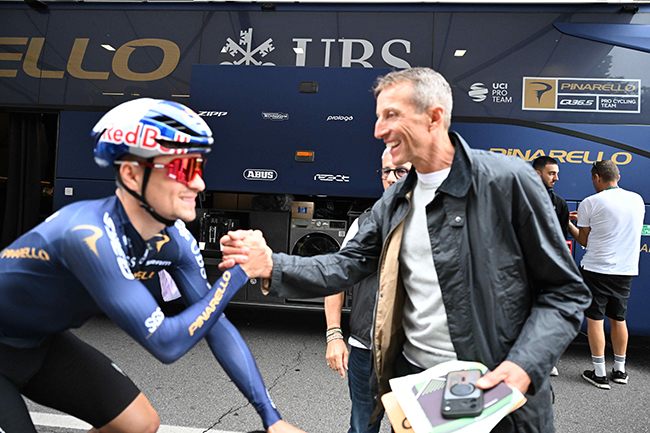
Tom Pidcock with Maurizio Fondriest before the start of the 2026 Tour of Lombardy. Sirotti photo
From the Spring Classics to the Grand Tours, from the team’s historic Tour de France debut to the final races of October, 2026 has been a season defined by ambition, resilience and collective commitment.
The team’s performances across a demanding international calendar have demonstrated not only the quality of its riders but also the strength of the organisation behind them.
Douglas Ryder, Team Principal of Pinarello Q36.5 Pro Cycling Team, said:
“Finishing 12th in the world is an outstanding achievement and a defining moment for our organisation. We are a UCI ProTeam competing against the very best teams in professional cycling, and this result demonstrates the strength of our vision, the quality of our people and the progress we have made together.
"What makes me particularly proud is that this achievement reflects the commitment, professionalism and belief of every rider, every member of staff and every partner who contributes to this project. We have built a culture where ambition is matched by hard work, where innovation drives performance and where every individual understands their responsibility towards our collective success.
"Tom's finishing fifth in the world, the highest ranking of his career, is another exceptional milestone. He is one of the most talented athletes in cycling, and his achievements reflect both his extraordinary ability and the environment we are building around our riders to help them perform at their very best.
"I also want to recognise our owners and partners, whose commitment and confidence in this project have been fundamental to our development. Their support allows us to think differently, invest in the right people and continue challenging the established order of professional cycling.”
A platform for the future
Beyond the rankings, the 2026 season has marked a defining chapter in the team’s evolution.
Competing in all three Grand Tours in a single season for the first time, establishing a presence at the front of some of cycling’s most prestigious races and achieving consistent results across different terrains and disciplines have strengthened the team’s position on the international stage.
The final UCI rankings provide measurable confirmation of that progress, while setting a new benchmark for the years ahead.
With a strengthened roster, continued investment in performance and a clear long-term vision, Pinarello Q36.5 Pro Cycling Team now turns its attention to 2027, determined to build on the foundations of its most significant season to date.
2026 UCI WORLD RANKING – KEY FIGURES:
12th – UCI World Ranking for Teams (19th in 2025)
10,863 points – Team total (8,188 in 2025)
+7 places – Year-on-year improvement
+32.7% – Increase in team ranking points
5th – Tom Pidcock, UCI Road Elite Individual World Ranking