

Bicycle Racing News and Opinion,
Tuesday, November 24, 2026
Back to news and opinion index page for links to archived stories | Commentary | Our YouTube page
The true measure of a man is how he treats someone who can do him absolutely no good. - Samuel Johnson
Bill & Carol McGann’s book The Story of the Tour de France, 2022: The Fastest Tour Ever is available in both Kindle eBook & audiobook versions. To get your copy, just click on the Amazon link on the right.
Upcoming racing:
- Dec 6: Superpresitge Ruddervoorde
- Dec 19: Scheldecross
- Dec 23: Azencross-Loenhout
- Dec 25: Heusden Zolder Cross
- Dec 26: Gavere Cyclocross
- Dec 27: Namur Cross
- Dec 30: Diegem Cyclocross
- Jan 1: GP Sven Nys
- Jan 16 - 24: Tour Down Under
Latest completed racing:
- Nov 15: Flandriencross-Torfee Hamme Zogge Bollekescros
- Nov 7 & 8 European Cyclocross Championships
- Nov 1: Trofee Oudenaarde - Koppenbergcross
- Oct 25: Superpresitge Overijse - Vlamse Druivencross
- Oct 13 - 18: Tour of Guangxi
- Oct 13 - 18: Tour of Holland
- Oct 18: Chrono des Nations
- Oct 18: Veneto Classic
- Oct 18: Japan Cup road Race
- Oct 14: Giro del Veneto
The rest of the year's completed races are here.







Content continues below the ads

Here’s the team’s announcement:
A bold design, tweaked to be more impressive: NSN Cycling Team has today revealed its 2027 kit, with the minor changes set to make its eye-catching roster stand out just as much in the peloton.
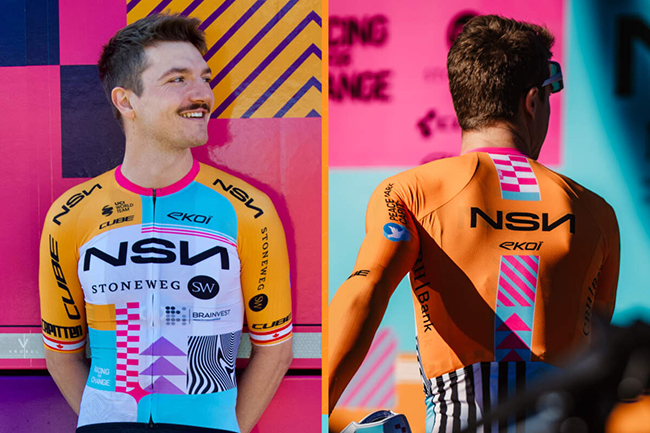
NSN Team's 2027 jersey.
Produced by EKOÏ and designed once again by Stijn Dossche of stycle.design, the 2027 kit adopts a stance of evolution over revolution. The bold colors and patterns that shaped NSN’s inaugural look are retained.
The biggest changes are on the arms and rear of the jersey, which are now predominantly orange. There is also a tribute to Fin Tarling, the much-missed NSN Development Team rider, with the #ForFin message.
Black bib shorts and the logos of CUBE, the team’s Official Bike Partner from 2027, Capitten, and CBH Bank are also new additions.
Content continues below the ads

Declercq's Team Soudal Quick-Step posted this:
After years as one of the peloton's most dependable domestiques, Tim Declercq returned to the Wolfpack at the end of last season - this time as a coach. He talks about swapping the saddle for the desk, guiding the team's young riders, and why the head still decides so much.
Tim's move from the peloton to the coaching staff could hardly have been quicker.
"It was really like coming home again, but sitting at a different table," he says. "I was still a rider until the Sunday, and on the Monday, I came into the Soudal headquarters. So, from day one I went from being a rider to immediately being a staff member. But I already had this ideal scenario in my head. I wanted to become a coach even before I arrived. I started my studies with this in mind. So to see it all come true, and with this team, is really a dream come true."
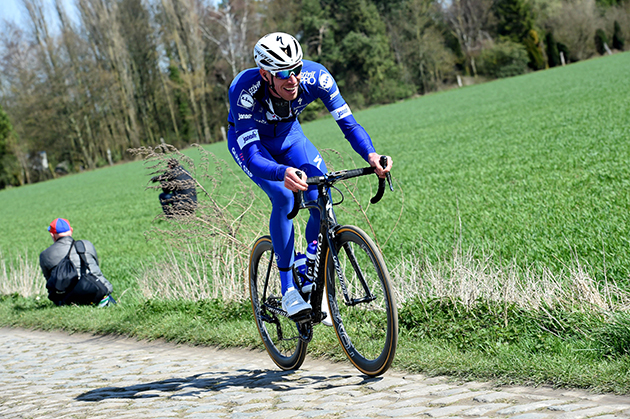
Tim Declercq checking out the Paris-Roubaix course in 2018. Sirotti photo
The biggest change? "Going from spending all your time outdoors to suddenly spending a lot of time behind a desk," he laughs. "It's a bit of a change, but it's nice."
The same passion, a different sport
Tim spent many years with the team as a rider, and he says the most important thing hasn't changed at all.
"What has stayed the same for sure is the mentality. We're really a team where everybody cares," he says. "People aren't just doing their jobs because they do it out of passion. Nobody is counting how many hours they're working, and that hasn't changed."
Content continues below the ads
The sport itself, though, is almost unrecognisable from when he turned professional. "Cycling has changed dramatically. In my first years as a pro, nutrition during races was completely different. It was really a different sport," he explains. "When I joined Soudal Quick-Step, you could already see the scientific revolution starting, and since then it hasn't stopped. I think that's one of the reasons the level has risen so much."
Tim's interest in the science of the sport goes back long before his studies at Ghent University and later in Brussels. "I always liked science and physiology, even at secondary school," he says. "Of course I want to know the practical takeaways, but I've always been very interested in the theory behind the practice. Sometimes I like to say I'm more a guy of the theory than of the practice!"
Taking on a degree while still racing was, at first, about preparing for life after cycling. Looking back, he sees it as much more than that – and it's something he encourages in the riders he now coaches.
"In hindsight, it was actually really helpful. I'd encourage riders nowadays to have different identities than only being a bike rider," he says. "They're already so professional at such a young age and they have to put in so much hard work. But if cycling is the only thing they have, then when it's not going great, they have nothing to fall back on and their whole self-esteem gets taken away. Having other things to focus on helped me a lot."
His studies also taught him an important lesson as a coach: what worked for him won't necessarily work for everybody. "Studies are always done on group averages. Even in well-established studies, you always have people who don't respond, or even go the other way," he explains. "It works on a group level, but not for everybody individually. I had to learn that I couldn't extrapolate what worked for me to everybody else. You also see hypes in science and in practice. A few years ago there was the hype of training low, and now we've really stepped away from that and moved towards high carbs. All those things make the job interesting."
More than a cycling coach
Working with riders who are still in their teens and early twenties, Tim knows his role goes beyond training plans. "You have to be not only a cycling coach, but also a little bit of a life coach, even it sounds a bit of a silly phrase" he says. "They're taking their first steps, and although a lot of them are already super strong physically, they're not completely mature yet. Being physically very good at 18 or 19 doesn't mean you have the maturity to deal with everything around cycling. It helps if I can play a role in that, because I know what they're going through and how it feels."
"There's also a big reward in that. When you can help them through a period where it's not going great, your impact can be much bigger than with somebody who's 35 and already knows what's coming."
So what does a typical week look like? "There's no average week," Tim smiles. "And from next year, I'll actually have more WorldTour riders than development riders."
His weeks are filled with team meetings, analysing riders' training files, and keeping in touch with physios, doctors and sports directors. He also follows the races closely – and helps with scouting. "I try to call my riders at least once a week, but I'm in contact with almost everybody almost daily," he says. "You're often the person closest to the athletes, so if they ask you after a race, 'Did you see that?', you can't say you didn't watch!"
After 14 years in the field, the move to working alone behind a desk took some getting used to. "From now on I'll try to work at least one day a week at the service course, to keep that connection with the team, which I really like and sometimes miss," he says. "I went to some of the development team's races and training camps, but it's always nicer to speak with somebody in person." He still has enough form to join his riders on the road from time to time – and he says some of his best conversations happen there.
"I'm lucky I still have a bit of a level, so if it's not too long – two hours, two and a half – I can still ride next to them. It's mostly with the Belgian riders, of course, but I always try to join them when I can," he says. "It's a privilege, and it's very useful. Some things stay private, but life stress all has an impact on training. As a coach, you don't need to know the details, but you need to know a bit about what's going on.
"When you're riding outside and having a longer conversation, you can go much deeper than just asking on the phone how it went. Especially with the young guys, it can be harder for them to say how they're feeling because they're not completely in touch with it yet. On the bike, you can ask better questions."
It's a job that doesn't keep office hours. "Some days you'll be working until 11 in the evening," he says. "But I don't mind, because everybody here is so motivated to do the job."
With so much data now available, Tim sees one of his most important tasks as keeping things simple. "There's so much data at the moment, and you can really get lost in it," he says. "An important part of our job is to see the forest through the trees – and to help our athletes see it too."
Asked about a moment that's made him especially proud, he chooses his words carefully. "Some things are personal, so I can't go into too much detail," he says. "But it's the moments where you feel you've really helped an athlete – not only physically, but through a more difficult period mentally, as a rider and as a person. Then to see that rewarded with good results afterwards is really rewarding."
Nobody is bigger than the team
As a rider, Tim was known as one of the hardest-working domestiques in the peloton. It's a mentality he believes must stay at the heart of the team.
"We really need to keep this mentality, that nobody is bigger than the team, and that the goal of the team is always bigger than the individual," he says. "I always think back to 2018 to 2021, when we had all those leaders for the Classics. It was still possible to make a team out of that, because nobody was bigger than the team. That's the Wolfpack mentality, and we should always keep stressing it."
"Even if somebody has their own ambitions, when it's really the moment to help out – for a sprint, for example – you're never going to ask them to ride 200 kilometres on the front, but just that little bit extra. Those things really make the team."
It's something he passes on to his own athletes. "They always need to follow the team orders 100 percent. And I like to see motivation in training. But you can't choose to be motivated, so I think that's where a coach can make the biggest difference – getting your athletes as motivated as possible."