

Bicycle Racing News and Opinion,
Saturday, November 14, 2026
Back to news and opinion index page for links to archived stories | Commentary | Our YouTube page
People understand me so poorly that they don't even understand my complaint about them not understanding me. - Soren Kierkegaard

Les Woodland's book Cycling’s 50 Craziest Stories is available in print, Kindle eBook & audiobook versions. To get your copy, just click on the Amazon link on the right.
Upcoming racing:
- Nov 15: Flandriencross
- Dec 6: Superpresitge Ruddervoorde
- Dec 19: Scheldecross
- Dec 23: Azencross-Loenhout
- Dec 25: Heusden Zolder Cross
- Dec 26: Gavere Cyclocross
- Dec 27: Namur Cross
- Dec 30: Diegem Cyclocross
- Jan 1: GP Sven Nys
- Jan 16 - 24: Tour Down Under
Latest completed racing:
- Nov 7 & 8 European Cyclocross Championships
- Nov 1: Trofee Oudenaarde - Koppenbergcross
- Oct 25: Superpresitge Overijse - Vlamse Druivencross
- Oct 13 - 18: Tour of Guangxi
- Oct 13 - 18: Tour of Holland
- Oct 18: Chrono des Nations
- Oct 18: Veneto Classic
- Oct 18: Japan Cup road Race
- Oct 14: Giro del Veneto
The rest of the year's completed races are here.







Content continues below the ads

The team posted this:
Four Rookies will be promoted to the WorldTeam in 2027. For Tim Meeusen, this is proof that the development programme is working. We spoke to the Director of Development about the Rookies project.
How does a youth team stay at the top when it loses its best riders year after year? For the Red Bull – BORA – hansgrohe Rookies, that is precisely the challenge. Following a 2026 season in which the development team was the best U23 squad within the WorldTour structure in terms of victories and UCI rankings, several winning riders and team captains are moving up to the WorldTour. 2027 therefore marks a new beginning for the Rookies.
Tim Meeusen (Belgium) is Director of Development at Red Bull – BORA – hansgrohe. In this interview, he talks about the philosophy behind the project, why he allows young riders to make mistakes, why Red Bull – BORA – hansgrohe is breaking new ground with its own off-road team, and why he believes the rejuvenated U23 squad is capable of securing victories at the highest level again in 2027.
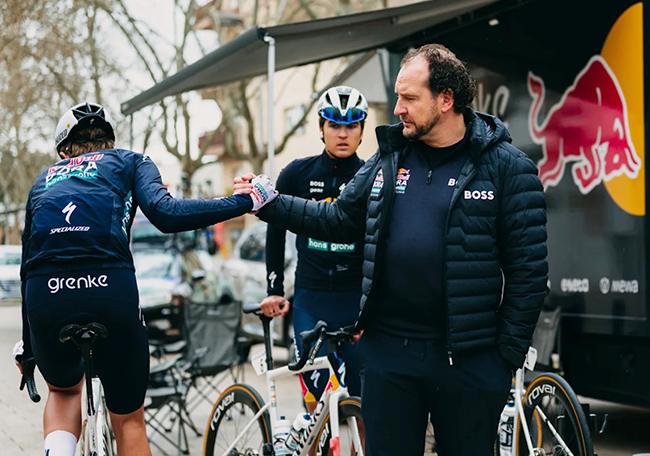
Tim Meeusen. Photo: Twila Federica Muzzi
Tim, in 2026 the Rookies won, amongst other things, the most important junior stage races in Italy and France. How would you assess this season?
Tim Meeusen: I’m actually quite modest by nature. But I think that, after this fabulous season, you can definitely say that we have one of the best structures in the world for developing talent. If you look solely at the victories and the UCI rankings, we’re the best compared to the other development teams in the WorldTour. I’m very proud of that.
With Davide Donati, Lorenzo Finn, Alessio Magagnotti (all from Italy) and Sebastian Putz (Austria), four key riders from the 2026 season are now moving up to the WorldTour. What does that mean for a development team?
Tim Meeusen: It shows how we work. Of course, we’re losing some of our winners and team captains. But that’s not actually a bad thing – after all, it’s precisely this that shows we’ve been successful in our work. And that’s the most important thing for a development team. We’re losing and gaining at the same time.
You’ve been involved in talent development in cycling for many years. What appeals to you personally about this role?
Tim Meeusen: For me, it’s a passion. It’s a dream to help young riders and support them on their journey to the WorldTour – from the U19s through the U23s to the pros. It’s not about stopping them from making mistakes. They should learn from their mistakes. Everyone makes mistakes in life – you, me, everyone. What matters is how you deal with mistakes and setbacks – on the bike and off it. And it’s really lovely to see how a person, an athlete, develops with us over the years.
Content continues below the ads

What sets the Red Bull – BORA – hansgrohe development programme apart from those of other teams?
Tim Meeusen: I believe we stand out because of the philosophy we apply to each individual rider. We don’t have a one-size-fits-all approach. There’s a framework within which we work, but within that framework we tailor our approach very much to the individual. We can adapt: we have athletes who develop very quickly, and others who need more time.
And you don’t just look at performance in races?
Tim Meeusen: No. Our strength lies in taking a holistic view of each individual. You can be a very good athlete and perform very strongly in races – yet still perhaps lack leadership qualities or the ability to communicate. We pay particular attention to that. We see the rider as a whole – on the bike and off it.
What qualities does a talented rider need today to make the leap into the WorldTour?
Tim Meeusen: As in any high-performance sport, you need a great deal of character in cycling too. When you’re involved in competitive sport, you miss out on quite a lot in life. But you also get a lot in return. Many young people these days play video games or go out with friends. As a cyclist or high-performance athlete, you have to look after yourself. You can’t go out partying or sit in front of the telly all day. You need an unwavering determination to become the best person and the best rider you can possibly be. In our group, I see a lot of passion, a lot of character, a lot of dedication – and a lot of trust.
Why is trust so important to you in particular?
Tim Meeusen: I think it’s very important these days to trust the people who want to teach you something. We see this particularly with the very young riders – they trust our programme and what we tell them. If we say we’re going left, then 99 per cent of them go left too. Of course, there are difficulties from time to time. But then we talk to them. That’s important.
Those at the very top of the world rankings could simply sit back and relax.
Tim Meeusen: That would be the biggest mistake we could make: to say, ‘OK, we’re the best, this is our structure, and we’ll stick to it for the next few years.’ The world is changing very quickly, and the world of cycling is no exception. We’re very pleased that our partners are committed to the long term – with equipment, sponsorship, everything. That allows us to plan ahead. But we need to think about what the next steps are – not just for the coming year, but for the next two, three, four years. By that I don’t mean results, but areas such as scouting, nutrition and training. Everyone needs to reflect on their own work and try to be the best in their role. Then we come together as a group and use that to develop a sound development philosophy for the coming year. And so it goes on.
The next step is already coming this winter in the form of our own cyclo-cross team. Why do you also see cyclo-cross as part of talent development?
Tim Meeusen: Personally, I have a great passion for cyclo-cross. I’m from Belgium; I grew up with cyclo-cross. But if you look at the results of the last Tour de France – the stage winners and the riders at the top of the general classification – many of them were multi-disciplinary athletes, particularly mountain bikers or cyclo-cross riders. So we said: we’ll take this step, see what it brings to our development programme, and launch an off-road team.
One example of this approach is Adrien Boichis (France): he came from mountain biking, progressed through the Rookies to the WorldTeam, and became World Champion in cross-country short track in 2026. How can you balance road and off-road cycling for young riders?
Tim Meeusen: Adrien continues to do both. Even in the U19s and the Rookies, we now have some very talented riders in cyclo-cross who are also strong on the road, and some who are also strong on mountain bikes. Our job is to strike a good balance and see what the future holds. If you take cyclo-cross away from them and send them out on the road exclusively, you’re not doing them any favours either. That’s why we’re keeping all options open.
What are your expectations for the 2027 season?
Tim Meeusen: As a development programme, we have to be realistic and start from scratch again. This year we had riders who were mature enough to win races, make their own decisions and even win the world’s biggest races in their age group. Next year we’ll be starting with a younger team. But I’m very confident that we’ll be competitive and able to win at the very highest level once again.
Content continues below the ads
Vallieres’ EF Education-Oatly team posted this.
Going into the world championships in Rwanda in 2025, Magdeleine Vallieres knew she wanted to push herself. So she came up with the mantra, “Full commitment, no regrets” and repeated it all the way to the top step on the podium. One year later, Mags prepared herself to race the world championships as the defending champion in Montreal, practically her backyard.
Mags looks back on her year in the rainbow jersey. From the highs to the lows, she experienced it all. Read on for Mags’ thoughts about her time as world champion.
Your mantra in 2025 was obviously successful. Did you plan to use it again this year in Montreal?
Yeah, it was the same as last year, so full commitment, no regrets. The “no regrets” is really the one that's going to be turning in my head the whole race, I think. Whatever happens on the day, whatever form, whatever legs I have on the day, whatever scenario happens, I want to give it my all and have really no regrets when I cross the line.
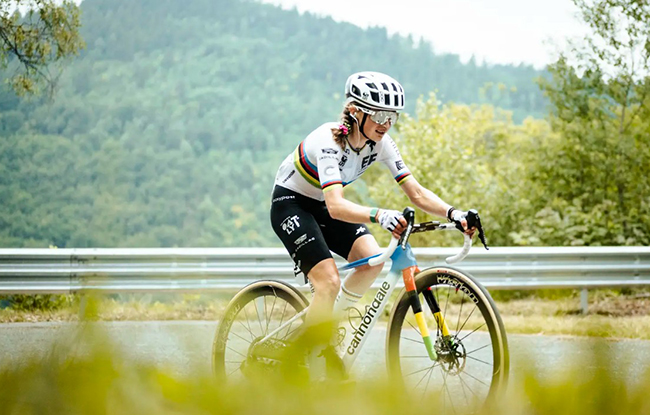
Magdeleine Vallieres in her Rainbow Jersey
In all the years you’ve been riding and racing, what has cycling taught you?
It taught me, in any situation, to find a way to adapt myself and just be tougher – when it's cold you go, when it's raining, you go. If it's nice you go, if it's a bad day you go. Sometimes maybe it's not always the smartest but I think as a kid it taught me a lot. Today, if we go into, let's say one of the Ardennes, pouring rain and super cold I'm like, “Yeah, it's pouring rain and that's fine. I'll do it and it'll be fun!” It made me fall in love more with the sport and also to create that kind of community with good friends that share the same passion. That also was a big big thing for me.
How did it feel to defend your world champion title at home?
From the start of the presentation I was super emotional to be honest. I mean, wearing number one at home and then seeing so many Québécois, Québécoises, Canadiens, Canadiennes there in front was super special. It was also special riding on the roads. Seeing everyone who had come to me for once, to my home and not me coming to their home. So it was super special.
Tell us about your day at worlds this year.
For sure it didn't go the way I wanted. I think even at one lap in, I was out of the race from a crash so it's definitely not what I was expecting but that's cycling and that's the risk of it. That's how it goes sometimes and it was out of my control. I decided I needed to step up in some way, everyone came to watch and I knew a lot of people were there to see me so I did two laps I think to say hi to everyone and then I stopped because it was time but I was glad I could see everyone and I think it even with this challenge, this crash, I think it was a beautiful day.
What went through your mind after the crash?
When I was on the ground Adèle Normand, one of my teammates at the race, stopped and she was like, “Oh, are you okay? I'm going to stay with you,” which was really nice of her because I think having someone in that moment really helped. And then Alexis [Magner] stopped and she told me a few words that actually stuck a lot in my head because I was a bit emotional, to be honest. I think that's normal. And she said, “It doesn't matter what happens today. You won it. You'll always be world champion in 2025 and you know. Always believe in it.”
It took me a lot to get my emotions a bit more in control so that's why I did two laps because the first one, I needed to say hi to everyone and but the first one I could not because my head was a bit all over the place. So on the second lap, I said, “OK, now I say hi to everyone.” I tried to make it worth it and a show for the people who had traveled a lot and just tried to make it a bit special. So I waved to everyone and tried to make everyone a bit cheery and have a smile.
What have you learned from your year in the rainbow jersey?
I want to be the best version of myself. And I'll work as hard as I can to get there. The jersey brought me... How can I say it? The jersey was the start, I would say. It was the start of me believing in myself and the start of pushing myself to go over these steps, these barriers. Just to dream and to believe in myself and in the team.
What were your expectations for being the world champion?
My expectation when I won the jersey was that there was going to be a lot more attention which there was. I'm lucky I had a good team to help me manage it in the best way possible. When I reflect on it now, I just think sometimes things were harder for me because it was pushing me out of my comfort zone a lot but it also came with so much good. I feel like I got closer to the whole team. It was nice to all believe in it together because we saw it was possible. So we saw we could all do it if we did it also together. And just seeing how it brings everyone together. With worlds [in Montreal], seeing how many people showed up and seeing that community, it creates something beautiful. If I can inspire a few people to pursue [cycling] and I saw that actually I did inspire a few people here in Canada and Quebec to to pursue cycling, so it makes me happy.
Is it important to you to feel a sense of community in the sport and to inspire others to ride?
When I see that it's inspired people, it makes me feel really proud. It makes me feel like it's all worth it, all the effort. Because you know you can do it for yourself, but it's a bit boring. I like to do it. I want to do it more for the larger community and to find a purpose in it. And if I can see a few kids that are happy because of it or pursuing a dream – it doesn't need to be cycling but if I can have an impact, then it makes it all worth it.
When I was younger, if I had been able to watch the worlds at home, for sure it would have inspired me so much. I could see the Grand Prix, and that was already a big inspiration for me. But watching the worlds, all the categories, I can already imagine the young kids watching. And I hope we can put stars in their eyes and hopefully get them inspired to ride their bikes.
Looking back on the year, how does it make you feel?
Proud. Proud of everyone. Proud of Quebec, of this event, and proud of the community. I’m proud of the year. I don't feel like it's only me, I’m proud of what we’ve achieved as a country, of how we’ve progressed in cycling.