

Bicycle Racing News and Opinion,
Friday, July 31, 2026
Back to news and opinion index page for links to archived stories | Commentary | Our YouTube page
Age appears to be best in four things; old wood best to burn, old wine to drink, old friends to trust, and old authors to read. - Francis Bacon

James Witherell's book Bicycle History: A Chronological History of People, Races and Technology is available in both print and Kindle eBook formats. To get your copy just click on the Amazon link on the right.
Current racing
- July 29 - August 2: Tour of Denmark
Upcoming racing:
- August 1: Clasica San Sebastian
- August 2: Circuito de Getxo
- August 3 - 9: Tour of Poland
- August 4 - 8: Vuelta a Burgos
- August 13 - 18: Arctic Race of Norway
- August 16: Cyclassics Hamburg
Latest completed racing:
- July 28 - 30: Tour de l'Ain
- July 4 - 26: Tour de France
- July 26: Vuelta a Castilla y Leon
- July 8 - 12: Tour of Austria
- June 24 - 28: National Championshps
- June 17 - 21: Tour de Suisse
- June 17 - 21: Baloise Belgium Tour
- June 7 - 14: Tour Auvergne-Rhône-Alpes
- June 14: Copenhagen Sprint
- June 14: GP Gippingen/Canton Aargau
- June 10: Circuit Franco-Belge
- June 7: Brussels Cycling Classic
- June 1 - 5: Ethias-Tour de Wallone








Content continues below the ads

We posted the report from GC winner Markel Beloki's Team EF Education-EasyPost with the results.
Here's the report from GC fourth-place Henrique Bravo's Team Soudal Quick-Step:
Tour de l’Ain ended up being a great race for Soudal Quick-Step, one of the youngest World Tour teams at the start. A top-three finish on the opening day netted by Alberto Dainese, solid rides from our Devo riders, both Henrique Bravo and Said Cisneros in the top ten overall, and the best team of the event prize - everything in just three days of racing.
It was the race that brought the month of July to a conclusion for The Wolfpack, and at the same time, a good opportunity for our young guys to show what they are capable of and punch above their weight against more seasoned riders. Bravo - making his first outing since triumphing at the Giro della Valle d’Aosta - finished as the best South American in an impressive fourth on the GC after being constantly on the attack in the last two stages, which brought plenty of climbing.
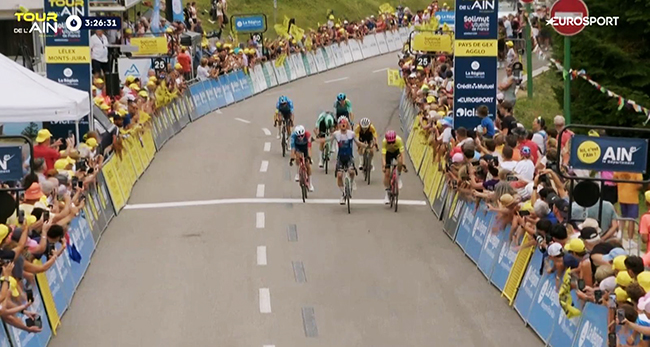
Axel Mariault wins the final stage with GC leader Markel Beloki finishing second
“We tried our best today, but it wasn’t possible to make the difference on the Col de Menthières despite our efforts. Then the last climb wasn’t that hard and it all came down to a reduced sprint, where I resorted to the last ounces of energy I still had to get a good result. Finishing just outside the top three it’;s a bit frustrating, but at the same time, I loved being on the podium with the whole team and enjoyed every single second there, because we all worked hard and it was nice to get that award”, Henrique said after the stage.
Once the race concluded, Gil Gelders took to the podium to receive his most combative rider of the day prize before being joined there by his Soudal Quick-Step teammates and sports directors Kevin Hulsmans and Niki Terpstra to celebrate winning the team classification, making it for the second time this season after the Giro di Sardegna, that our squad took this award.
Content continues below the ads

Here's the Tour de l'Ain report from Brieuc Rolland's Team Groupama-FDJ United:
From being disappointed to bouncing back. Off the pace during Wednesday’s first showdown between the general classification contenders at the Tour de l’Ain, Brieuc Rolland reacted impressively on Thursday in the third and final stage of the French race. Although dropped by a handful of favourites on the Col de Menthières, the young Breton fought his way back to the lead group thanks to a superb descent before securing an encouraging third place at Lélex Monts-Jura. He therefore scored his first podium finish of the season.
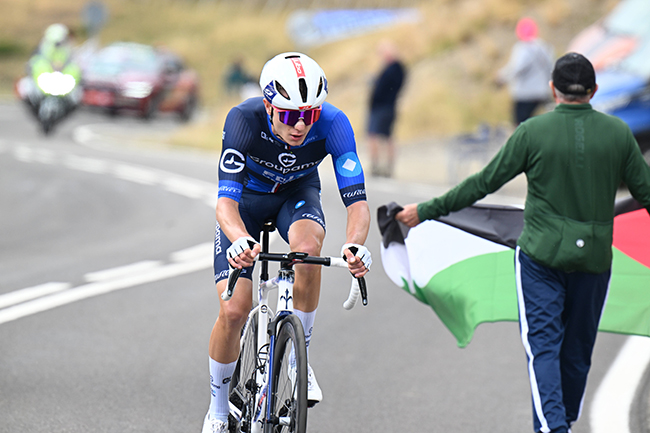
Brieuc Rolland racing in the 2025 Vuelta a España. Sirotti photo
Following the only stage dedicated to the sprinters, the Tour de l’Ain took a complete turn on Wednesday with Stage 2 from Saint-Vulbas to Lagnieu, featuring two ascents of the Col de Portes (14.5 km at 5.5%). It was the first real test for the general classification contenders, and unfortunately Groupama-FDJ United came up short. The team’s only survivor after the first ascent, Brieuc Rolland was unable to match the pace of the strongest riders on the second climb, around forty kilometres from the finish.
“It was a surprise,” explained William Green. “He was fighting on the first ascent, but just exploded on the second. Looking back, we can assume he simply hadn’t recovered enough after a very intense training block over the past two weeks. Combined with the heat, that probably explains his performance, but we don’t want to make excuses. It was an important race for both Brieuc and the team, and the result wasn’t acceptable. We can’t make these mistakes. Once he realized he was no longer in contention for a top ten overall finish, he eased off because there was still another stage on Thursday and we wanted to turn things around.”
To bounce back, the team had to tackle an even tougher course on Thursday. Although only 130 kilometres long, the final stage featured 3,000 metres of elevation gain across seven classified climbs, including the Col de Menthières (9 km at 6%), before a long uphill false flat to the finish in Lélex Monts-Jura. Groupama-FDJ United approached the race exactly as planned by placing Johan Jacobs in an early eight-man breakaway.
“We really wanted to turn things around after yesterday,” said William. “Everyone was highly motivated and we wanted to make something happen on the final climb from the breakaway. The plan was to have both Johan and Brieuc up the road. Unfortunately, the start wasn’t hard enough for Brieuc to bridge across despite all his efforts. Still, it was very positive to have Johan in front because it meant we could use him later. Once the race became harder, the break split apart. Johan was really strong, but before the final climb I asked him to sit up and wait for Brieuc, which he did. He was then able to help close the gap to the lone leader while allowing Brieuc to start the final ascent in a good position.”
The Col de Menthières began with thirty kilometres remaining, and after only a few hundred metres the favourites launched an acceleration. Brieuc Rolland was unable to respond immediately. “For sure he wasn’t at his normal level, but he was climbing better than the day before,” William explained. “When the favourites accelerated, he couldn’t match the pace, but he kept believing and kept fighting. Just before the summit, he attacked the group he was in, and then on the descent he took nearly a minute to come back to the front of the race. It was really impressive to watch.”
Nearly twenty kilometres after seeing the favourites ride away, the young Breton bridged back to a seven-man lead group alongside another rider. The final twelve kilometres then consisted of a gradual uphill drag towards Lélex Monts-Jura. “It was obviously all-in for the stage win,” William added. “The general classification battle was also going on, and we took advantage of that. Once Brieuc made it back to the front group, he managed his energy very efficiently.”
The 22-year-old stayed therefore in the wheels as the finish approached. With less than two kilometres to go, Jefferson Alexander Cepeda tried to anticipate the reduced sprint with a late attack, but the final 300-metre uphill stretch stopped his attempt.
In the end, the stage was decided in a hard-fought sprint, where Brieuc Rolland claimed an excellent third place. “He didn’t have the legs to attack and go solo, so we went for the sprint,” said William. “Brieuc did his best to stay well positioned, and I don’t think he could have done much more in that final. It simply came down to the legs. He certainly spent a lot of energy getting back to the front, but after yesterday we can be very pleased with third place. We came here wanting to produce a result on GC and we’re really far from doing that. It’s disappointing, but I don’t think it’s a significant issue, just a small one. There’s plenty of racing to come, and I think Brieuc just needs some more recovery. We’ll soon see him back at his best, and I believe this result has given him some confidence again. It’s always difficult to work so hard for a race and then experience a setback like yesterday. You start asking yourself a lot of questions. This morning we had a good briefing and a clear strategy. We wanted to finish this race and go home with a smile on our face, after giving our maximum. That’s what we did.”
Content continues below the ads
Here’s the team’s update:
Emirati team announces its squads for the Clásica San Sebastián and the Circuito de Getxo, with the welcome return of Jay Vine to racing
Ahead of the pair of prestigious one-day races in the Basque Country, UAE Team Emirates-XRG is pleased to confirm its lineups for both the Clásica San Sebastián and the Circuito de Getxo.
The Clásica San Sebastián is first up on Saturday, 1 August, and the Emirati squad will return with last year’s runner-up, Jan Christen. The recently-crowned Swiss national road race champion will be part of a powerful UAE Team Emirates-XRG squad that will hope to add to its victory from the 2024 edition.
Won by Marc Hirschi two years ago, the Clásica San Sebastián will host its 45th edition this time out, and see UAE Team Emirates-XRG led by Sports Directors Tomas Gil and Marco Marcato in the team car. At their disposal will be Christen and his teammates Igor Arrieta, Benoît Cosnefroy, Jhonatan Narváez, Pavel Sivakov, Kevin Vermaerke, and Jay Vine.
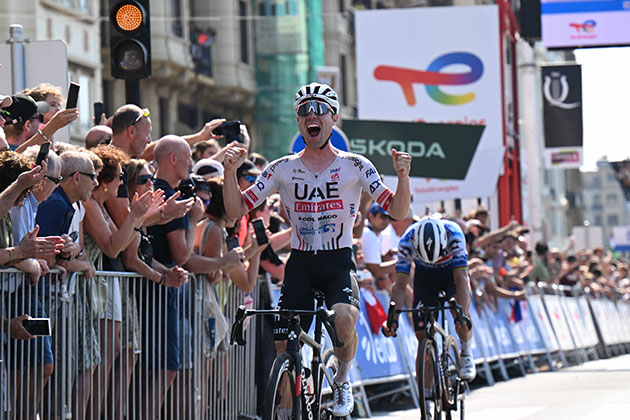
Marc Hirschi wins the 2024 Clasica San Sebastian.
Vine will be making his much-welcome return to racing following his rehabilitation from a race-ending crash suffered on stage 2 of the Giro d’Italia. Narváez, who went on to win three stages in Italy, will be making his first appearance since the Tour de Suisse.
Elsewhere, Arrieta comes to the Basque Country fresh from a runner-up spot at the Clásica Ordizia, where the Spaniard raced on the front foot alongside the American, Vermaerke. Cosnefroy will make his Clásica San Sebastián debut on Saturday, with Sivakov looking to put his legs to the test after a productive spell of training across Andorra.
The Clásica San Sebastián is often a great meeting point between those holding their form from the Tour de France, and those beginning their build towards the Vuelta a España – making for an exciting combination.
Last season, it was Christen who impressed most for UAE Team Emirates-XRG, with the Swiss rider making a series of bold attacks that ultimately delivered him to second place on the Boulevard de San Sebastián. That day, the 22-year-old was only bettered by Giulio Ciccone of Lidl-Trek.
This time out, there have been minor changes to last year’s route, with the riders heading slightly further west between kilometres 5-75, but otherwise it is a traditional Clásica San Sebastián course.
Beginning and ending in San Sebastián, the 221.2km-long route includes a whopping 4,050m of elevation gain. Two uncategorised climbs get the day underway within the first 45km, before a further seven categorised climbs are scattered across the parcours.
The crux of the route begins after 150km, when the riders begin to climb the Jaizkibel, which stands at 5.4% for 8km. This tough category two ascent is quickly followed by the Erlaitz, which averages a whopping 11% for 3.8km. Summitted with around 40km to ride, the Erlaitz usually draws plenty of attacks, and we can expect this year’s race to be no different.
A quick descent follows the climb, before a near 20km stretch of rolling roads.
To provide one final twist, the Murgil Tontorra (2km at 9.8%) comes after 211km, and ends with just 8km to ride to the finish. This brute of a climb certainly offers one final point of rupture for those vying for victory.
A day after the Clásica San Sebastián, the Circuito de Getxo will be held in the Basque town on the outskirts of Bilbao. First raced in 1924, the Circuito de Getxo is also known as the Memorial Hermanos Otxoa, with the race dedicated to the memories of former cyclist Ricardo Otxoa and his twin brother Javier, who died in a crash in 2001.
Hosting its 81st edition this year, the Circuito de Getxo will provide its usual challenges to the peloton. Standing at 175.4km and with a little over 2,200m of elevation gain, the race is suited to the Classics specialists who are equally adept on short, punchy climbs.
Perhaps the most decisive point on the route will be the tough slopes of the Alto de Pike, which stands at 9.3% for 2.1km, and was used on the opening day of the 2024 Tour de France.
After a tough afternoon in the saddle, the day’s honours will ultimately be decided on an uphill finish to the line in Getxo. Here, the successor to Isaac del Toro will be crowned, with the Mexican having won last year’s race for UAE Team Emirates-XRG.
Victories from Del Toro in 2025 and Juan Ayuso in 2022 offer UAE Team Emirates-XRG plenty of good memories at the Circuito de Getxo, but it will be up to a new crop of riders to seek the same success this time out.
Arrieta, Sivakov, Vermaerke and Vine will continue from the Clásica San Sebastián to the Circuito de Getxo, where they will be joined by teammates António Morgado, Domen Novak, and Marcos Freire (Gen Z).
As for the team car, directions will be given by Sports Directors Marco Marcato and Aner Moreno.