

David Stanley
2026 Tour de France Week One Round-Up
David Stanley is an experienced cycling writer. His work has appeared in Velo, Velo-news.com, Road, Peloton, and the late, lamented Bicycle Guide (my favorite all-time cycling magazine). Here's his Facebook page. He is also a highly regarded voice artist with many audiobooks to his credit, including McGann Publishing's The Story of the Tour de France and Cycling Heroes.
David L. Stanley
 David L. Stanley's masterful telling of his bout with skin cancer Melanoma: It Started with a Freckle is available in print, Kindle eBook and audiobook versions, just click on the Amazon link on the right.
David L. Stanley writes:
A look at the first nine stages of the 2026 Tour de France
1) The new-style Team Time Trial is a winner.
I’ve heard all the gripes on social media. (Yes, all; sadly, I frequent Bluesky, Facebook, Instagram, Reddit, Threads, & Twitter. But only during the Tour. I can stop whenever I want to.) - It’s not a true measure of team strength. It’s just a 20-km lead-out. It’s too big a penalty for the riders who aren’t team leaders with huge time gaps right from the start. I read them all. They’re all wrong. With the new design, teams no longer have to depend upon the fifth fastest man on the squad.
The course design, with almost all of its 200 meters of climbing 3.5 km from the finish, was a true test of the riders’ speed, endurance, and power output. Right from the outset of Day 1, it created excitement in the GC. As a bonus, we saw teams hit absurd speeds over 38 mph/60 kph on the flat sections and nail an average speed of around 34 mph/55 kph for the full day’s work. The teamwork of the TTT; it’s like watching the Blue Angels High-Performance jetfighter team. A thing of beauty is a joy forever. Kudos to the Équipe de Conception de Parcours ! Chapeau !
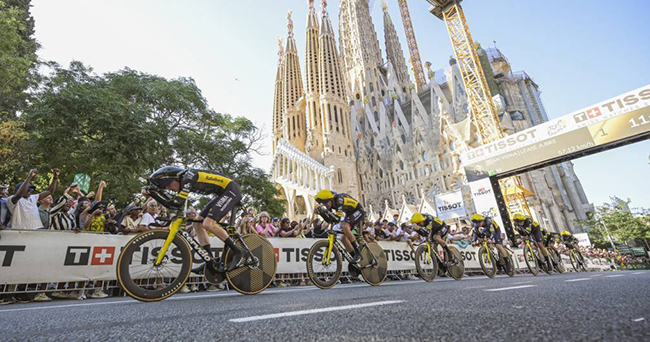
Team Visma | Lease a Bike blasting by the Sagrada Familia church in Barcelona. ASO/Charly Lopez photo
2) Announcers need to stop saying that drafting doesn’t matter on the climbs.
True enough, the draft doesn’t matter as much on the very steepest sections of the very steepest climbs. But those sectors are less common in today’s modern game. In the opening team time trial, Jonas Vingegaard was at 21 mph/34 kph on a 9% section of the last climb. If you were on the wheel of a more normal sized climber at that speed, you’d save as much as 40 watts (per data obtained via the CCA website.) For comparison, the oversized derailleur pulleys from Ceramic Speed, the OSPW, might save you 2.5-3 watts over a normal pulley set. Of course, a Tour-ready set of those would also cost your team US $2,100, but hey, you’re worth it.
3) Tim Merlier is fast. Very Fast.
By my hand timing, the peloton covered the final kilometer of Stage 7 in 50 seconds. That’s an average of 44.5 mph/ 72 kph. I saw data from Velon that showed a top speed of 49 mph. It’s not just Tim. Look at the list of sprinters from stage 7. Merlier, Wærenskjold, Girmay, Kanter, Philipsen, Bauhaus, Artz, Godon, Pederson—that’s enough horsepower to keep the A/C running in the team hotels for a night. As Merlier crossed the line, first thing he did was brush his shoulders off. I wonder if he’s still popping his collar. As for Stage 8, he was terribly placed in the last 750 meters. He had to close a 20-meter gap at 38 mph just to get to the front, and then he jumped again to win going away.
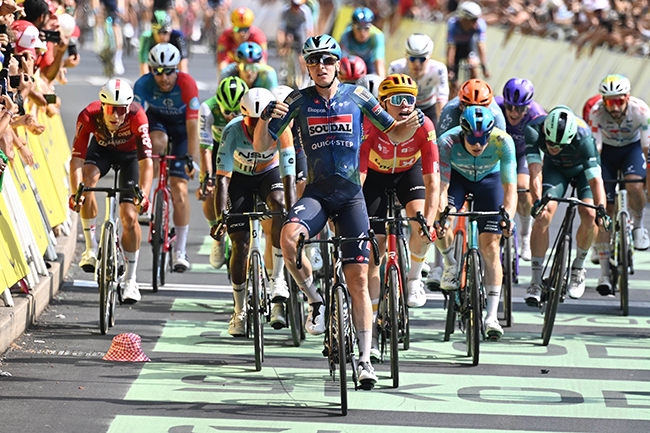
Tim Merlier winning stage seven. Sirotti photo.
Merlier doesn’t upload his data but 5th place Pavel Bittner did. Bittner’s max HR was 208 over the sprint. He averaged 1302 Watts with a peak of 1,526 W. Bittner’s peak cadence was 116 rpm with a peak speed of 45.7 mph/73.6 kph. That’s pedaling a 56x12 (130 gear inches in old money) at 105 rpm for the gearheads out there. And poor Pavel, despite those insane numbers, Merlier blew Pavel’s doors off. If they were dragging for pink slips, Merlier would be going home with a lovely LaPierre bicycle. Tim Merlier, the fastest man in the world. (s/o to Aaron Stanley for the data.)







Content continues below the ads

4) The Road will Decide is rarely a good strategy.
I’m a big Remco fan. Always have been. I’m also a Florian Lipowitz fan; I have him in my Velogames.com fantasy team and believe that he’s just a bit of a late bloomer. At 25, we now see his true abilities. But when you have two talents so close in Grand Tour abilities, and one of them is under a massive contract and has been anointed a Belgian Golden Boy, it’s not good management to tell them that they are co-leaders. Remco worked hard for Florian in Catalunya on the last stage to help Florian secure 3rd place overall, while Remco himself certainly could’ve challenged for that same podium spot as he finished just 43 seconds back of his teammate. Fairly, Evenepoel said Lipowitz refused to provide a crucial lead-out in the finale.
Stated Remco, "I asked for a lead-out and didn't get one. I think I was rightly angry.” Team DS Zak Dempster said that everyone was back on the same page. We all know and love that Remco will always speak his mind. Yet, as the race wears on, and nerves fray even more, it’ll be interesting to see 1) when this occurs again; 2) will management finally assign roles to their two very talented stars so perhaps they can feature in a week 3 challenge to Tadej Pogačar; 3) It was reported that they shared a table at dinner that night and there was much frivolity. Perhaps it’s the dinner table that will decide.
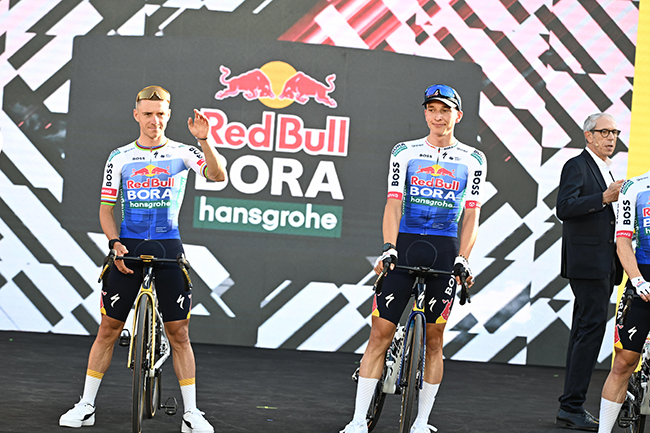
Remco Evenepoel (left) and Florian Lipowitz at the pre-race teams presentation ceremony. Sirotti photo
5) We Don’t Need Another Hero (oh, wait, yes we do & it’s Baptiste Veistroffer)
Baptiste is this year’s Tour de France hero. With his attacks on the flat stages, despite full knowledge that his chances of a win are nil, he charged and we cheered. As of Friday, he’d spent 310 km off the front after 1,000 km of racing. The 26-year-old from Brittany attacked alone from the gun on stage 5 to Pau and attacked again during stage 7 to Bordeaux, where Jakub Otruba (Caja Rural-Seguros RGA) soon joined him. The two were never let go by the peloton but animated the long, hot ride to Bordeaux. Veistroffer has been nicknamed 'Le Sanglier', the wild boar, by the French press for his big build and aggressive riding. On his Instagram he posted, “A long stage without a breakaway is pretty stupid.”
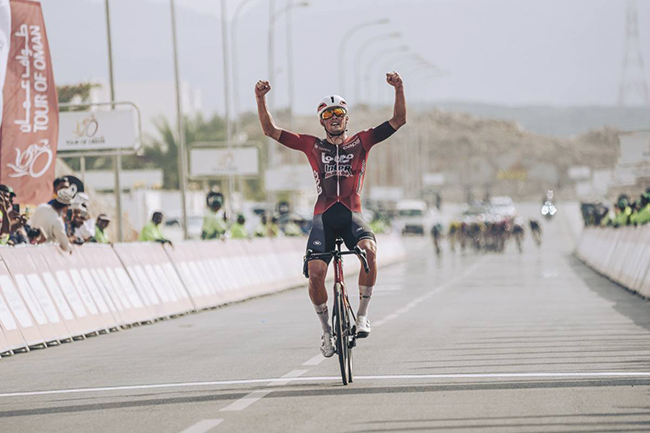
Baptiste Veistroffer winning stage two of the 2026 Tour of Oman.
Content continues below the ads

6) Never underestimate Mathieu van der Poel.
The 31 year old Dutchman is not only absurdly fast, model-handsome, and an eight-time world cyclocross champion, he is a rider that on his type of course, say for example, stage nine of this year’s Tour de France, a man who simply cannot, will not, be beaten. He pulled the 4 man breakaway for the last 2 km to keep them clear of a rapidly closing peloton. Even still, none of his companions were able to draw close at the finish. That gives MvdP plenty of satisfaction for this year’ Tour.
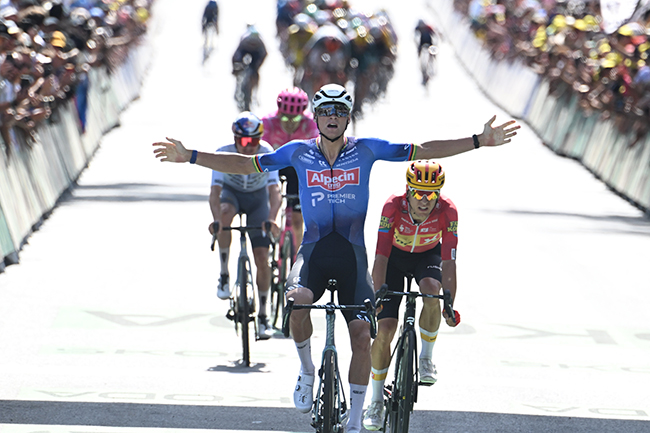
Mathieu van der Poel wins stage nine. Sirotti photo
7) Tadej Pogačar is the outlier’s outlier.
Simply, there is no one in the peloton with his capabilities. Did you watch him on the Tourmalet? I could stack adjectives up from sea level to the 6,939 foot/2,115 meter summit of the Col du Tourmalet and it would be inadequate. He rides with intelligence; he is never poorly placed. He and his team have mastered his nutritional requirements. He is among the finest time trialists in the sport, as fast as the specialists like Remco and Filippo. He understands effort. His abilities on the descents put a sphincter-tightening Fear in all who watch.
When he attacks uphill, the attack is always 100%. Complete and utter havoc is in his wake. The gap opens instantly. If someone does manage to jumar back up to his wheel, we all know that another attack, again full-gas, is on the way. You know it’s coming, and there is nothing you can do as he rides off except try to maintain your gap over the riders behind you and be satisfied with 2nd place.
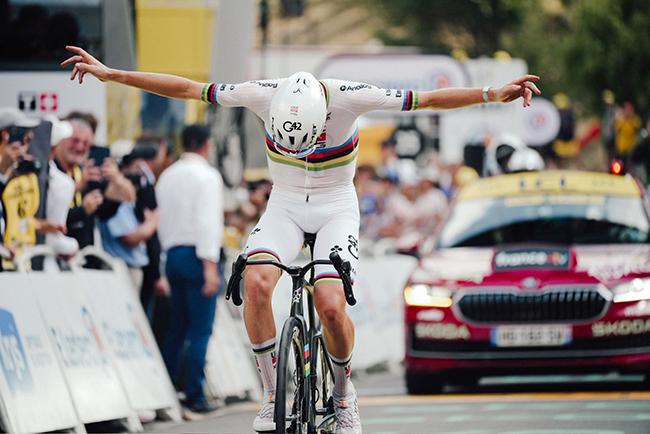
Tadej Pogacar wins stage six in style while wearing the World Road Champion's rainbow jersey. Sirotti photo
8) Stop whining.
Again, it’s all social media nonsense - “Tadej’s killing my love for the Tour. He’s made the Tour boring.” Or some such nonsense. Look, fool (said in Mr. T voice): While Eddy didn’t retire until 1978, his last truly wonderful season was 1975, right? It’s been 51 years since we’ve had such a generational talent in cycling. When James Holzhauer was winning $2,464,216 in his 33 appearances on Jeopardy, were you rooting for him to lose? When Tiger Woods was winning every golf tournament in sight, people didn’t whine that he made golf tournaments boring.

Eddy Merckx winning stage 12 of the 1970 Tour de France. Sirotti photo
Even non-golfers turned out in massive numbers to watch a man walk 300 yards, hit a little white ball over the grassy knoll, and then repeat it until he tapped it into a hole. If Tiger was ahead after the second of four rounds, he won the tourney 78% of the time. He won 82 times in total. When Michael Jordan and his Bulls won 6 NBA titles in 8 years in the 1990s, people didn’t whine.
Everybody, their brother and their sister and all their children, walked around in Bulls jerseys with a number 23 on them. Rafael Nadal is the most dominant player in French Open history, holding an unmatched record of 14 titles and a 112-4 win-loss record. There is no tournament tougher than the French, played on the terre battu clay of Stade Roland Garros, and the more he won, the more he was idolized. My point, and I do have one, is that generational players are rare. In cycling, perhaps due to the brutality of the sport, they are the rarest of the rare. We are witness to a run of success unprecedented in cycling since the end of the Viet Nam War. Quit whining and enjoy the ride; it will end soon enough. Not even Tadej can attack and escape from the Gods of Time.
Content continues below the ads
9) A New Unwritten Rule.
I’m not a fan of the unwritten rules, in general, in most any sport. But there’s a new one, and I like it. Let’s back up 20 years. In 2005, the UCI changed the 1km to the finish rule (all riders in a flat stage group finish who suffer a crash or mechanical in the last 1 km, as long as they finish the race, receive the same time as the leaders) to a 3 km to go rule. In 2024, the Blazers, in concordance with SafeR, decided that a 4 km, or even a 5 km rule was wise. In 2025, it was amended to a multi-rider crash. That means that in this Tour, if riders were involved in a crash within 5 km to go, or merely drifted to the back of the peloton to avoid entanglement with the sprint squads, they would not be penalized with any time gaps. That’s the written rules.
Now, the unwritten – in this year’s Giro, to avoid putting Jonas Vinegaard at risk, Visma-LAB began a team slide to the rear at the safety mark. This allowed to sprinters and their lead-outs to sprint full-gas without the GC teams being present. That protected the GC leaders from mayhem. Vingegaard, earlier this week to Eurosport said, "We will try to sit a bit more in the back, and stay safe there. I hope other GC teams will do the same. I think it will make racing a lot easier and a lot safer."
Tadej Pogacar agreed when he said at his post-race press meet, “I must also say that the 5km rule makes quite a big difference in the sprint stages because now there's kind of an agreement that we sit in the back, the GC riders, and we keep calm and it's much less stressful. There's always going to be a possibility for crashes, but I think we managed pretty well. So thanks to all the GC contenders as well for this respect. So far, it's one of the most enjoyable Tours, except for the heat."
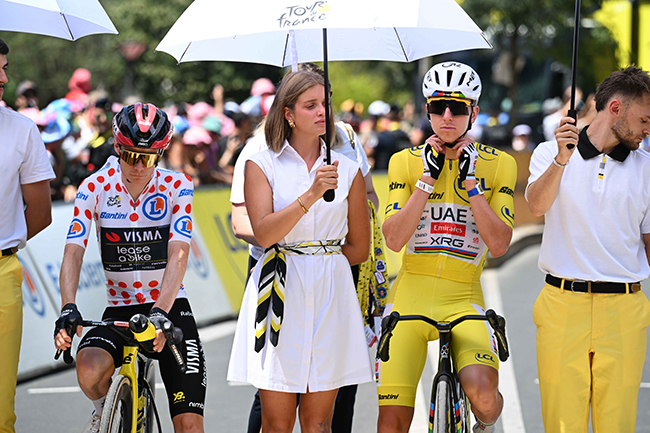
Vingegaard and Pogacar at the start of stage eight. Sirotti photo.
10) The Heat is On.
The weather has been unbearable. Saturday 11 July 2026, the high in Bordeaux was 102F/39C. The humidity was 55%. That’s a heat index of 134F/57%. At sea level remember, water simmers at 185F/85C. To expect athletes in any endurance sport to perform safely and at a high level in that sort of weather is beyond absurd. It’s damn near criminal. “Well, it’s always hot in the summer and riders in the Tour have managed.” And maybe they did. Except the Tour has never had to deal with such extreme temperatures. More on that later. “We’ve always done it that way” is one of the most moronic statements ever uttered by any moron. Stage 8 started at 1:15 PM local time. Peak heat danger time.
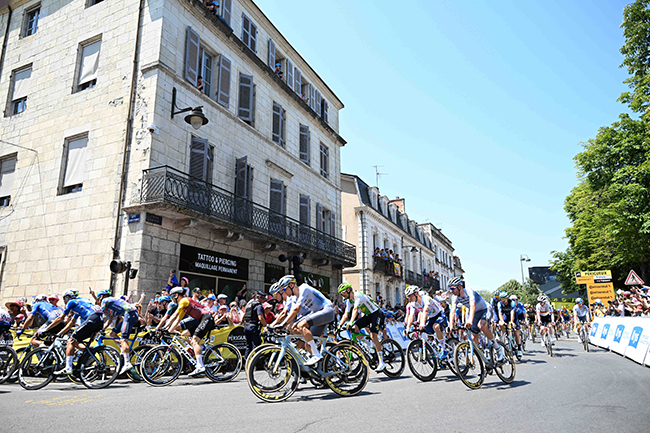
Stage eight starts as Mr. Sun has really gone to work warming things up. Sirotti photo
Here’s an idea. Start the stages at 9:00 am. Yes, the morning routine will change. Yes, people will be unhappy. Too damn bad; people can get used to all sorts of things. When heat exhaustion hits someone in the bunch, and a huge crash results, there will be much wringing of hands and talk of rider safety. Blazers, stop measuring sock height and the calculations on how many Euros should be charged for a village to be host to an intermediate sprint and be pro-active, just this once. The riders’ union, CPA, a released lengthy statement on this. Here’s a soundbite: "Given the increasing frequency of extreme heat waves, the CPA reaffirms that summer race start times must evolve in order to protect athletes' health. Riders remain fully committed to putting on the best possible show, but this must go hand in hand with adapting to the climate realities that cycling now faces. The CPA urgently calls for discussions to be held with all stakeholders this winter, in order to find a solution before the 2027 season.”
In closing, here is my open letter:
Dear ASO and UCI: in 1950, the average August temperature in Bordeaux was 72F/22C. The average temp last summer was 83F/28C. The single day August high temp, 1950, was 91F/32C. Last summer’s August high in Bordeaux was 107F/42C. Our climate has changed. You need to change the race format before we are faced with the sight of riders’ being choppered off with heatstroke as their competitive drives override their body’s cooling systems and they are far too close to death. That happened in 1967. We all remember Tom Simpson. Today, right now, you have the chance to put a future horrific wrong to right. Be on the right side of history, Blazers.
David Stanley, like nearly all of us, has spent his life working and playing outdoors. He got a case of Melanoma as a result. Here's his telling of his beating that disease. And when you go out, please put on sunscreen.