







The Stelvio
And Other Legendary Climbs
Are you crazy Chairman Bill? You're going to take that body up the Stelvio?
My wife Carol and I had decided to spend a few days in the Dolomite Mountains before the 2002 Milan Bike show. I wanted to ride a few of the legendary climbs that filled Giro history.
Mauro Mondonico tried to warn me. "These are real mountains," he said. He made it clear that those climbs in the Apennines and Apuan Alps that we ride up in the 19 or the 21 with a rare drop to the 23 had nothing in common with the climbs of the Dolomites and the Alps. "These are climbs that break the legs of the greatest professional riders. You must respect them."
So, being a dumb Irishman, I asked Mauro to put a 26 on the Torelli Countach I keep at his house and headed off to the mountains. Fools rush in...
Our first stop was Bormio, just at the base of the famous Stelvio Pass, maybe 20 kilometers from the southeast border of Switzerland.
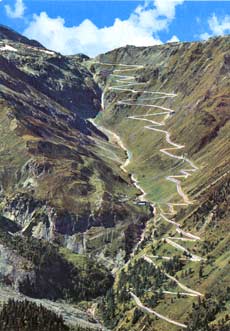
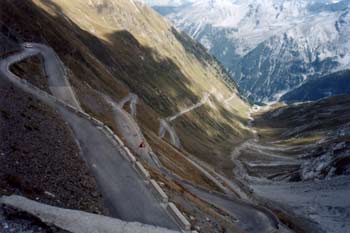
The Stelvio Pass: Years ago, when I first saw pictures of the Stelvio's ascent from the north side (shown above), I knew I had to ride it. Finding an opportunity combined with at least minimal fitness was the problem. This year I managed to get in a couple hundred miles a week during the high bike selling season. I wasn't in embarrassing condition although I wasn't what I would call fit. The weather looked to be good in late September on the high passes. I answered the powerful siren call of the terrible climb.
Since this famous road holds such a fascination to cyclists, race fans and motorcyclists, let's pause a bit. Its history is interesting. There is evidence that the pass was used as far back as the bronze age as a route to get from what is now Tyrol to Italy. At the end of Napoleonic wars the winners (Russia, Prussia, Britain, etc.) held a convention, the Congress of Vienna, in which these triumphant imperialistic powers worked to impose the old order on Europe. They set about redrawing the map of Europe. The northern region of Italy of which Milan is the capital, called Lombardy (Lombardia in Italian), was given to the Hapsburgs who ruled the Austro-Hungarian Empire. This transfer of territory was to make up for their loss of the Netherlands. Italy as a country did not then exist. It was several separate countries, mostly ruled by other European powers.
The Austrians wanted a road to give them a clear communication between Austria, the Val Venosta and Italy through the region of Valtellina. The Italians were rebellious and control was impossible without a pass through the Dolomites. Plans to build the pass were made in 1813, but they were abandoned. In 1820, the Hapsburgs made another attempt and with 2,000 workers completed the incredible engineering feet in 1825.
After Italian independence and unification in the 1860's the top of the Stelvio was the border between Austria and Italy. After World War One, South Tyrol (more territory north of the Stelvio) was given to Italy. Today, the entire pass is in Italian territory.
In the 19th century, recognizing its importance, the pass was kept open all year long. Today the Stelvio Pass is not considered essential. Other passes and modes of transport render the Stelvio far less important. I saw a Range Rover back up and maneuver to make it around some of the sharp hairpin turns. It's just not practical for modern trucks to use. Now the pass is usually closed between October and May.
When the Stelvio was first paved in 1938, it was the highest paved pass in Europe and today remains the highest Alpine pass. I believe that today the only one higher is the Iseran and that by only 14 meters. The Stelvio was first used in the 1953 Giro that saw Coppi's famous win. It's been a few years since the Giro has included the Stelvio.
The city of Bormio is at 1200 meters elevation. The top of the Stelvio is 2728. The average gradient of the Stelvio is about 7.5% with maximum elevation of about 13%. I think one reason it is so famous is that about half of the climb is above tree level and can be seen from above, making for a very powerful and dramatic sight. There are tougher climbs in Europe. The Mortirolo, only 50 kilometers to the south, is considered the hardest. But the Stelvio is legendary. There are no flat places on the Stelvio, somewhere a person can keep riding and get a bit of rest.
Sunday, September 15
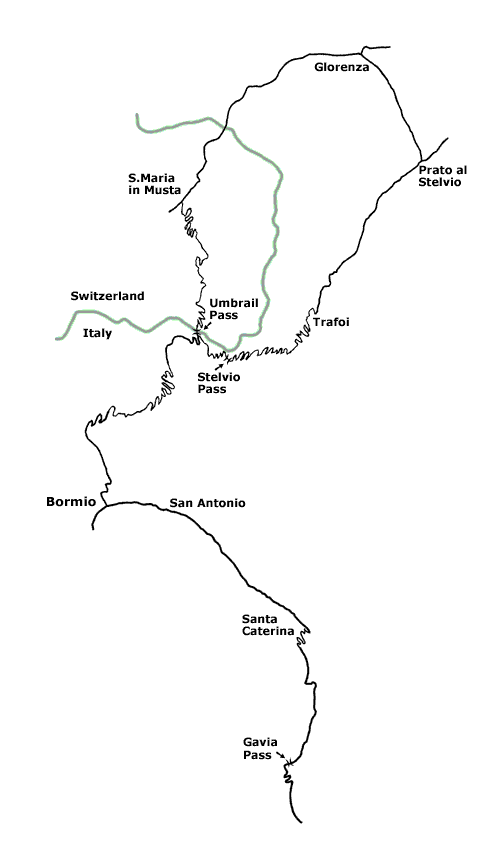
While I had originally planned to ride to the Stelvio from my hotel, I decided that I might be both just a bit too jet-lagged and off-form to do both sides of the climb. I broke my rule of never driving to a ride. I put the bike in the car and drove the 15 kilometers to the start of my loop, the road north into Switzerland, the summit of the Umbrail Pass. It's only about 300 meters in elevation shy of the Stelvio summit. I wanted to do a clockwise loop that would put me at the bottom of the climb warmed up.
I found a place to park and got out of the car.
Holy Mackerel!! It's cold up here at 2 miles high at 9 in the morning. I dived back into the car to put on more wool. I wondered if I should do this. I could see my breath and was planning a 10 mile, steep descent. My pusillanimous side started to talk to me. I didn't listen to the cowardly voices inside me. I again became resolute. I put a little steel back in my spine. What the heck, I'm here. I've got my bike, four Clif Bars, lots of water, spare tubes, pump...
Or, in the words of Sir Walter Raleigh, "Fain would I climb, yet I fear to fall".
Queen Elisabeth replied, "If thy heart fails thee, climb not at all."
Down the hill. If no one hears a descending cyclist scream because it's so cold, does he make a sound?
I held it to 10 mph down the very steep mountain pass. I was shivering so much the front wheel shook.
The very start of my ride was at the Swiss border. The crossing was entirely deserted. The entire descent is in Swiss territory, down what is known as the Umbrail pass and continues into Switzerland for about 20 kilometers through the little town of Giogo di Santa Maria into Santa Maria in Musta. The Umbrail Pass is the highest pass in Switzerland.
The road switched and descended very steeply. I look at the map now and it's all about seven to 12 percent gradient. Then, already having trouble keeping the bike stable as my chest muscles heaved and shivered in the cold, the paved road turned to packed dirt with little gutters in the road from rains. The Umbrail is the last major pass in Switzerland that is unpaved. No land speed records this morning. For all my problems keeping the bike stable, it must be a picnic with modern rims, tires, dual pivot brakes and modern brake pads compared to what great riders of the past faced. I can't imagine descending that pass with the old wooden rims and brakes used by men like Coppi and Girardengo. What courage they must have had. Well, I wanted to get a taste of Giro history and glory. I got more than a taste, I got a four-course meal.
As I got towards the bottom, the air started to warm. My bike started to go straight. Now there were farms with pastures and cows whose giant Swiss cowbells made a loud and constant tintinnabulation. The evidence of dairy farming became obvious to both my nose and my tires as I passed over an astonishing number of cow pies in the road. They became ever more common until they about completely covered the road. Are the Swiss trying a new system for paving their roads? I do prefer asphalt.
A week later, when I got back to the US, I described this descent to Larry Theobald of CycleItalia. He had helped me plan my trip. "Wait a minute! Be sure that everybody who reads your story understands that it was your idea to ride down that mountain, freezing your ass on the descent to Switzerland on a dirt road covered with cow poo. This decision had nothing to do with me or CycleItalia!". So noted.
I reached a beautiful valley at the base of the descent. The sun shone on the meadows that covered the lower hillsides. Pretty Santa Maria in Musta passed by. I could start pedaling and get some body heat going. After about 5 kilometers of this almost flat road, I came to the Swiss-Italian border and was waved on through back into Italy. I stopped to ask a lady who was sweeping the sidewalk in front of her store for confirmation that I was on the correct road. I started to talk to her in Italian and got a blank look. I switched to German and was told that I was indeed on the road to "Glurns" (Glorenza in Italian). All the places here have two names, a German one and an Italian one.
This region of Italy is really Germanic in character. As you read in the history above, this region has been traded back and forth between countries. More often than not, we were greeted with a "Gruss Gott" or "Guten Tag" rather than with a "Buon Giorno" while we were up in the Dolomites. The houses are alpine, with lots of geraniums growing in flower boxes on the balconies. It makes my Italian friends crazy when I say this, but this area is really Italian in name only. Certainly the food, language, and architecture is Germanic. The German name for the Stelvio Pass is the "Stilfserjoch".
At Glorenza I turned south-east and had a neat tailwind blow me down the road. On either side of the road apple orchards were heavy with their fall fruit. It was an interesting sight. Normally I ride in Italy in early April. Then the grapevines are just budding. Most of the trees are just coming out of their winter dormancy. Now, the grapevines were sagging with their purple riches. Everywhere, the harvest was starting.
 |
|||
|
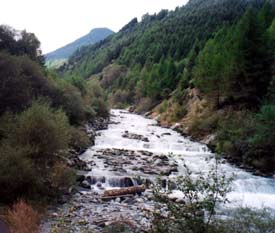
The Solda River runs alongside the ride. |
|||
The lower Stelvio is beautiful. The road is lined with a thick forest and a rushing river roars by the side of the road. I pressed onward. I was already in the 21 and my heart monitor said 155. It's warm here. I've taken off my jacket and arm warmers, but I still have on 3 jerseys (2 wool), one of which is a long-sleeve. I contemplated stopping and peeling off some insulation. But I knew that very shortly it's going to get much cooler. I was very right. After only another 5 kilometers I was comfortable with what I was wearing even though I was working almost as hard as I could.
After about another 5 kilometers it started to get steeper yet, now it's in the seven to twelve percent range. I put it in the 23 and watched my speed go down to 12 mph.
Somewhere around the town of Trafoi the first of the numbered switchbacks appeared. There are 48 of them, and each is numbered. The descent to Bormio on the other side of the summit has 34. To compare with a well-known standard, the L'Alpe d'Huez in France has 21 switchbacks. The elevation here is 1543 meters. I had done a little more than 600 meters of vertical climbing out of about 1,800 and was already feeling my legs soften.
 |
||||
|
Number 48: looks harmless enough. |
||||
There were lots of cyclists on the road, almost all of them going the same direction, tackling the Stelvio from the classic north side. Most were on mountain-trekking bikes. All had triples except for me. The entire day, I saw no one with a double on the hill as I passed many riders. A lot of them had on big backpacks, really big ones. Now that's work.
At this section of the climb, the switchbacks weren't very close together. It was just a straight grunt up the mountain. I knew I had a lot of switchbacks to go, so I tried to keep my heart rate under 170 so that I wouldn't run out on energy before I ran out of mountain.
Off to my left, across the valley, the sharp, steep sheer limestone face of the Ortles range of the Dolomites with its glaciers was a fantastically beautiful sight. Now the switchbacks (tornante in Italian) started to came at me. This being Sunday, the motorcycles were pouring up and down the hill. They were always courteous and gave me plenty of room. The only objectionable riders were the usual ones that every American cyclist knows, the morons on Harleys with straight pipes. Just as they pass, they open the throttle and give a blast of painful noise to show how strong and cool they are. Twisting that throttle takes a lot of muscle. Harley riders over here ride just as rudely as they do back home.
I had climbed beyond the treeline now. It's a treeless blasted moonscape. I learned something else on this road. Time and again I have seen the greatest pros, including Indurain, Armstrong and Hamilton, bonk. They ran out of food at a crucial time on a crucial climb. How could they let this happen? These men are very experienced pros and are very well managed by the best cycling minds in the world. Now I know. The level of effort is so high, so intense, so sustained and without respite that one's energy stores go from adequate to zero unbelievably fast. Several times on this climb I could feel weakness coming and I stopped it with some quick chow. I never did actually bonk. I knew was very close to running out of gas several times even though I like to think I know how to manage my food on a long, hard ride.
Just riding alone I didn't have the pro's problem of chasing Casagrande or Garzelli up a mountain. During a race the opportunities to eat can be very hard or impossible to find. I was just riding at my own tempo and almost in trouble. From now on, I'll cut these fine riders some more slack. I really didn't know how powerfully climbs like this stress the body's stores.
With about 20 switchbacks to go, the summit is in sight. It looks like it is straight up. Out of the saddle, in the 39-26, I was using all I had. In all my life, I have never had to work so hard
 |
|||||
|
Number 24: half down, half to go. |
|||||
 |
|||||
|
Looking back down: almost to the top now. |
|||||
10 switchbacks to go. The road has been carved out of the sheer face of the mountainside with barely room for two small cars. It is so very steep and I start to wonder if I am going to make it. I know I will, but this is far and away the hardest physical effort of my life.
Someone has painted the kilometers to go on the road. Do I thank him or do I hate him? Now there is 1 kilometer, and then 500m and it straightens out.
I'm over the top. I look back. What a sight. Snow on the far mountain and the road falling off far into the valley and out of sight,
(Info on a CycleItalia tour that includes the Stelvio, Gavia, and Mortirolo)
At the top there is a crowd of kitsch shops with tourists filling the narrow road. I'm shot and don't want to anything but get back to the hotel and get into a hot shower. It's still very cold at the top, even at 1:30 in the afternoon so I put on my windtex jacket and head down the 10 or so switchbacks to the car.
It took me almost 4 hours to go the 39 miles of the loop. Marco Pantani and Roberto Heras don't have to worry about me. This was, without a doubt, the single hardest thing I have done on my bike. It was also, far and away, the most beautiful and satisfying ride of my life.
Regarding gearing. For my friends in Southern California there is an easy gauge. I ride the Mulholland Highway from the ocean side to the top with a 39-21 with a drop to the 23 at the final top part if I really hammered it and have started to run out of gas. If you need more than that to comfortably ride the Mulholland, get a triple to do something like the Stelvio or the Gavia. If you plan to ride day after day, get the triple anyway.
As I drove down to Bormio, I was really glad that I didn't try to do both sides of the climb. The south side is much milder, but I would have been in trouble if I had done the double.
When I got back to the hotel, Carol had been into town. She found a park ranger station in Bormio and was able to learn about hiking in the area. The Stelvio climb is only a small part of Italy's huge Stelvio National Park. We wanted to see some of the beauty of the area on foot.
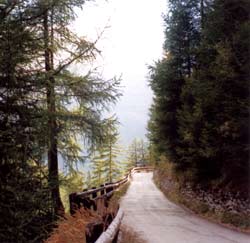
We chose to hike that afternoon in the Zebru Valley, a few kilometers east of Bormio. We were lucky again. After a short drive we arrived at a beautiful little river valley with trees shading the path. We were prepared with
 |
||||
|
Walking in the Val Zebru. |
||||
After hiking in this paradise for a couple of hours I was really finished. We called it a day and headed back to the barn.
Monday, September 16.
I had plans for the day, ambitious plans. I wanted to ride south from Bormio and do the Mortirolo pass and the Gavia pass (scene of Andy Hampsten's famous Giro clinching ride in atrocious weather in 1988).
I was feeling, shall we say, a bit fatigued from yesterday's sport. I called my Italian cycling master, Mauro Mondonico, to get his feeling on the subject. He has driven every climb in Italy at least once as the number one driver for RCS Sport, the promoter of the Giro. He has also cycled most of the roads of Italy. He said that he thought the Mortirolo was stupifyingly hard, and that I probably only had suds for one "hors category" climb. If it is to be just one, it had to be the famous Gavia. Mauro said that he has seen the Mortirolo just break the legs and dreams of the best pros, who often use a 26 themselves on this climb. The riders in the "Autobus" (the sprinters and rouleurs who ride together to finish within the time limit of the hard stages) often have a 29 on their back wheel for climbs like this. Among climbing connoisseurs, the Mortirolo is considered the hardest climb in Italy, and along with the Angliru in Spain, among the two toughest climbs used in grand tours.
That settled it. The Gavia it is, and only the Gavia. I rolled out of Bormio and after only about 4 kilometers, it started to go up and over 12 percent!
 |
|||
|
La Gazzetta has marked the start of the Gavia climb. |
|||
As Virgil guided Dante into hell, there was the sign at the entrance to the gates of hell, "Abandon all hope, ye who would enter here". But, Dante pressed on and so did I. Very early on, I had to put it into the 23 and then the 26. I more or less left it there for the rest of the ride. The next few kilometers were again, very pretty, in a thick forest with a rushing river to keep me company.
Eight kilometers past San Antonio, I reached Santa Caterina, and there the switchbacks started. Bormio is at 1,200 meters, Santa Catarina is at almost 1,800 meters. The Gavia summit is 2621. So, out of the 1,400 meters of vertical climbing that I had to do, I had 600 of them under my belt. RCS Sport's literature puts this side of the Gavia at a 6.5% average with a little spot of 14%. After some tough switchbacks I passed, gasping and wheezing, a couple who had just climbed out of their car to view the summits across the valley. "Corragio (courage)!" she said to me. I looked that bad?
So far, I had begun to think that the Gavia was a bit kinder, easier road to ride. Then, as series of crushingly steep switchbacks started and they took all I had. Again, like on the Stelvio, I wondered if I would make it. I wasn't going to quit the climb, short of falling off my bike. But after the Stelvio's gentle effect on my legs, this was hard work. There is one particluarly good thing about the Gavia. There is almost no traffic. In the couple of hours I spent climbing, probably fewer than 15 cars passed me.
It started to flatten out a bit. The road had the feel of coming to the top of the mountain. But not yet. I could get it into the 23 and get my speed up to 10 - 13 mph. And then, even though it was uphill, I had a tailwind that let me drop into the 21. I felt like a speeding fool.
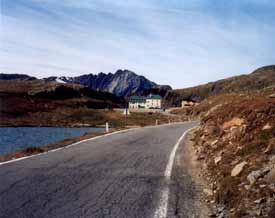
And after riding around a little lake and a couple of buildings standing by the side of the road, there it was, the summit. In the words of Phidippides, "Rejoice, we conquer". But I seem to remember that he then dropped dead.
 |
 |
||||
|
Lake along the Passo Gavia |
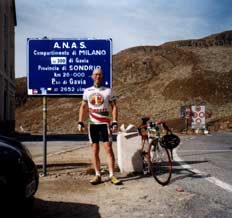
Made it to the top of the Passo Gavia! |
||||
There was almost no one in sight. The place was almost deserted. A lady was huddling in a car. I pointed to my camera and asked her to take my picture by the summit sign. She was kind enouigh to leave her warm car. My simple camera gave her a lot of trouble even after I pointed everthing out to her and turned the camera around so that she didn't take a picture of herself. I don't know what my pictures will look like.
Not wanting to get cool, I put on my armwarmers and jacket and climbed back on the bike. Right at the summit, there is a pile of newspapers for riders to stick under their jerseys for insulation. I thought I was fine, and was. So I didn't take any papers, leaving them for riders who would need them.
I headed back down the slope. With the exception of some really steep parts of the switchback section, it was possible to get up a good head of steam. On the steepest section, I excercised real care. If I let off the brakes from 10 mph, almost instantly I was going over 30.
By the way, the reason why I have written of speeds in miles per hour and, yet list many distances in metric units is that my cyclometer is calibrated in miles, but the road markers and maps are metric. I hope it isn't confusing.
I got back to Bormio for a ride of about 30 miles that took about 3 hours.
After a good, hot shower and a quick sandwich, we drove over the Stelvio and headed east for the little ski town of Corvara in Badia.
The little town sits in a valley just at the base of the Passo de Gardena and Passo Campolongo with the magnificent Dolomite massif, "Gruppo Sella" thrusting up out of the earth, dominating the tiny city. In the distance, the great Marmolada mountain looms, glowering, always covered in snow.
Larry Theobald of CycleItalia Tours told me that the only hotel to use was the "Sporthotel Panorama". As I write this, we've been here for an entire day now, and he's right. This hotel with its friendly hosts enters my pantheon of great inns for cyclists. It's not great because of a wonderful building (it is) or ancient reputation or army of bellhops with their hands outstretched. It's a great hotel because the owners have but one goal, to make the guest happy. And, it's all done with a generous liberality that most American innkeepers could and should learn.
Am I the only one that feels that everytime I turn around in most American hotels the management is trying to chisel me? I make a local call and I'm dinged fifty cents. I hate this. I complain and I am told that this is to help pay for the telecomuncations system. What, phones aren't part of the hotel building? How about a bath surcharge to pay for that soap and those towels? Oh, I'm getting started again...I just hate to pay what appears to be an agreed upon price and I find someone's hand in my pocket charging energy surchages and reservation charges and whatever else they can dream up to add to the bill.
Here, at the Sporthotel Panorama in Corvara, dinner is included in the price of the room. The room was the size of Montana and cost about $150.00 a night for the two of us. We ended up being stuffed that evening after eating only 3 of the endless courses of superb food. Because we didn't have room for dessert the owners were disappointed. We were not partaking of all they had to offer.
Nice going Larry! And the food was fantastic!
Tuesday, September 17.
No cycling today. Instead, Carol and I decided to go hiking in the hills. The scenery was almost overpoweringly beautiful. In the morning, the breakfast room was filled with very serious looking hikers. They had on knickers with wool socks, poles, backpacks, expensive sunglasses, all the high-end technical gear. I was a bit intimidated. I was wearing my new sneakers and old jeans. I felt dowdy compared to these serious-looking athletes.
Hiking here is convenient. Carol and I were able to just walk out the door and start hiking to the top of the near hill. In a little while we saw some of our high-tech breakfast mates coming down the hill. Sonofagun! No wonder these people have this trick hiking gear. They are obviously serious, strong walkers who made it to the top of the hill and are already on the way down. I was dumbfounded.
Sweating and breathing hard, we made it to the top of the hill, which was also the top of a ski lift. People were pouring out of the building and heading down the hill. The mystery was solved. These guys were getting all dressed up to get on the ski lift and then walk down the hill.
We got back to the hotel and the Sporthotel people did it again. They asked us to join them in a picnic for lunch. We walked out and the owner was holding out 2 glasses of champagne for us. We were fed gobs of delicous food on the hotel lawn overlooking the city amidst the almost 360 degree view of the mountains. When we said we had had enough, once again, these generous and liberal people were again disappointed that we didn't eat everything in sight. And there was no extra charge put on our bill for the lunch.
For the afternoon, we took a ski gondola to the top of one of the mountains. Now I am convinced that the little wires from which the gondolas are suspended will give way at anytime and probably do, but it's all covered up. No one talks about it. So, by my taking ride on one of these sure deathtraps, I knew I was taking my life in my hands. Carol, not understanding my rational appeciation of the terrible danger these devices represent, just climbed aboard, ignoring my white knuckles and rapid, shallow breaths. If possible, the view from the top of the mountain was even more spectacular. I survived my date with sure death. This time the suspension wires did not give way and drop us down into a deep limestone gorge. We were lucky.
Wednesday, September 18.
Another dream day of cycling was in order. This area is the Giro. This year (2002) stage 16 of the Giro ended in Corvara after coming in from the Campolongo side. This was where the brave Jens Heppner of Telekom finally cracked and passed the Pink Jersey to Cadel Evens. Stage 17, that dramatic stage that saw Paolo Savoldelli take the lead of the Giro for good while Dario Frigo, Cadel Evans and Tyler Hamilton all blew up started here in Corvara. These two stages took in most of the roads and climbs I was planning on riding today.
The Gruppo Sella Massif can be circumnavigated from Corvara on a ring road. This route takes in some of the legendary climbs of Italy: The Campolongo, the Pordoi, the Sella and the Gardena. A choice must be made when laying out the ride. After the first climb, the Campolongo, one can turn right and head for the Pordoi or turn left and ride the Marmalada, also called the Fedaia. The Marmalada loop is harder and longer. Everyone that I talked to agreed that the Pordoi is a much more beautiful ride. I chose the more beautiful road.
The clockwise loop starts with Corvara at the 1:00 o'clock point on the circle and heads due south. The first climb, the Campolongo is pretty easy. While I did use the 26 a lot, it was at 10 mph. I never felt that I had to dig deeply to get over. The descent wasn't too technical.
Then, almost immdiately, the Pordoi climb started. This was tougher, but not a leg buster. I think there were 33 switchbacks, each of which was numbered.The sun was out. The weather was beautiful. I reached the top with plenty of energy left. At the top of each climb, I had to stop and have a snack and put on my warmies. Then, at the bottom, where the air is warmer I had take off the jacket.
 |
|||||
 |
|||||
 |
|||||
|
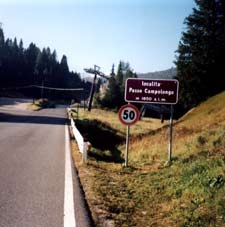
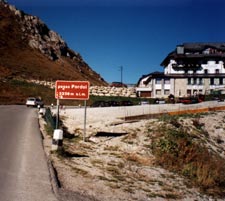
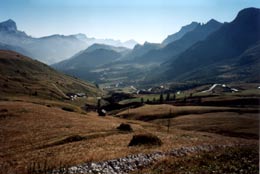
Above: the tops of the Passo Campolongo (left) and Passo Pordoi (right). To the left, scenery along the Passo Pordoi. |
|||||
The Pordoi descent was fabulous. Deep valleys with thick forests made the air temperature cool on the downhill roll. Left over from the 1999 Giro were the names of racers that the tifosi had painted on the road.
I used to think I was serious about sport, and on occasion, even a bit tough. No longer. I encountered the strongest, toughest guys I have ever seen. Coming up the Pordoi were cross-country skiers on roller skis, training for the winter season. These men were climbing the Pordoi very fast on skis with poles..... up a 10% grade. I have no idea what they planned to do at the top. How do you descend on roller skis?
At the bottom of the Pordoi, I took off my jacket and started the climb of the Sella. This one was a stiff one. It averages 6.6% with patches of 11% to 12%. The ascent of the Sella from the south to 2,244 meters is not that different from the Pordoi's 2,239, but either my legs were starting to get shot, or it was a lot steeper. I'm sure it was both. I was starting to feel the day's ride towards the top. It wasn't anything like the leg-busting, lung-searing effort of the Stelvio, but the third pass did have its effect. This road on this climb took me right up next to the sheer face of the mountains. Mountain climbers were getting out of their cars with ropes and other various devices used by these gents to defy gravity and what I assume are the direst pleadings of their mothers. Along the road people were out of their cars with telescopes and binoculars watching the climbers. In the region, it seems that everyone lives for sport.
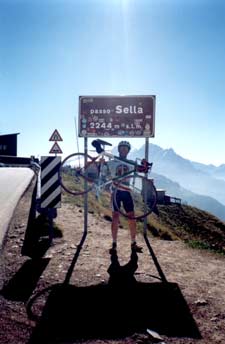
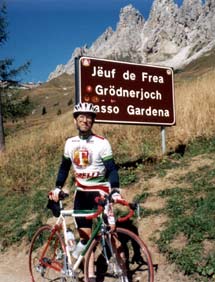
At the top of the Sella, I stopped for a bit of food and met a nice Austrian couple getting ready to go for a hike (a real one). They kindly took my picture by the summit sign. We started talking about the history of the area. "This area is ours, you know, it really is," the Austrians said. Clearly not everyone accepts the verdict of the post World War 2 plebescite that took this part of Italy from Austria.
I relayed this conversation to an Italian friend and he reacted like Daffy Duck with his eyes on springs and his beak sticking a foot in front of his head. "What!?! The Austrians can't have this, it's ours and it always will be."
 |
||||
 |
||||
|
Top of the Passo Sella (left) and Passo Gardena (right). |
||||
Then, the last climb, I thought. The Gardena is fairly easy, but still fantastically beautiful. The descent is rippingly fast with some nice banked corners at the switchbacks. I got lucky. I started at the top behind a giant tour bus. They go maybe 15 mph down these hills. He saw me in his rear view mirror and pulled over. I big-ringed it into town.
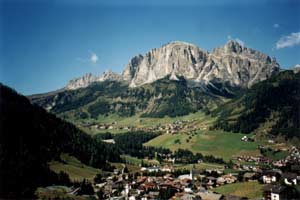
Then, the climb to to hotel. The Sporthotel Panorama gets is name from its fantastic views. Views are usually achieved by being high up on a
 |
|||
|
Corvara in Badia, seen from the Sporthotel Panorama. |
|||
Carol was watching me come up the hill from the hotel. She noted that I didn't go up the hill very fast. Everyone is a critic.
35 miles that took about 4 hours.
Thursday, Septemeber 19
We drove to Milan. I hated leaving. My five days here in the mountains were extraordinary. Already I find myself going back and looking at the snapshots we took, bringing the memories back in a way that rarely happens to me.
Friday, September 20
The European trade show season remains a fragmented mess. Before the 1990's, the system was very efficient. The Cologne (called "Ifma") show was held in even numbered years in September and The Milan Show (called "Eicma") was held in odd-numbered years in late November. Each year one could see everything that Europe had to offer at one show in a couple of days. The Cologne show emphasised bikes from the big manufacturers and was dominated by French, German and other northern European companies. The really big Italian companies also came to Cologne. The small specialty Italian bulders could afford to show at Milan, given that it was only every other year and close by. We didn't know how good we had it.
Then a new show, Eurobike, in Friedrichshafen, Germany started. It emphasized mountain bikes at a time when mountain bikes absolutely dominated the world bike market. It was an instant hit. Because Eurobike is held every year, the other shows, to defend their turf, also went to a yearly schedule. On top of that, there is the regional Salzburg show and the London show at almost the same time. It's chaos. It requires that a visitor or exhibitor choose his show carefully, understanding that if he visits or exhibits at just one show, he will miss a lot.
A manufacturer now has to exhibit at 3 or more shows to see the same number of customers he used to see at one show.
We chose the Milan show, of course. Italy is where our heart is and it is still the heart of cycling. It is still where the finest components and frames are made: Campagnolo, Vittoria, Columbus, Modolo, 3T, Mondonico and all the other magical producers. I could go on, but no other country spawns such a wealth of magnificent cycling goods as this miraculous peninsula.
It seems that each year's show has some overriding theme, some product or innovation that sets the tone. After Tonkov's Giro victory in 1996 on an aluminum bike, the Italians went into shock. The shows that year had oversized aluminum bikes everywhere. The industry scrambled to meet the change.
This year it was carbon fiber. It was everywhere. Last year, all bikes had carbon forks and some had carbon seat stays or complete rear triangles. This year carbon bars were everywhere, stems that were mostly carbon were at each maker's stand. Columbus had a kit whereby a builder may insert a carbon top and down tube with various profiles available
There was even a carbon fiber mini-pump.
The other general impression was that the vast majority of racing bikes used integrated headsets. There were some who used hidden sets. I wasn't looking, but I don't think I saw a high-end bike at the Milan show with a regular pressed in headset. American shops and distributors are fighting this trend very hard, preferring the ease of servicing that a regular headset offers. The other concern most American shops have is that most bikes sold go out with at least a centimeter of spacers between the headset and the stem, to lift the bars to the correct height.
The integrated system deprives the assembler of about a centimeter of bar height, requiring him to add even more spacers to the steering column, negating the intended effect of a seamless, beautiful front end to the bike.
Our first important appointment was with Oria, who produces our double-butted Vanadium tubesets that we use on our Corsa Strada. As high-end steel tubes are getting more and more scarce, we had to make sure that we could get tubing for our most popular frame for the whole season. We were told that were about the firm's only steel tube customer. My, how times change. They gave us a great price on the tubing so that we can continue to offer a near pro frame for an entry-level price.
That done, we sat down with the Corsa Strada's builder. He's a good guy and builds very high-end frames for some very famous names. I still don't know how he gives us the Corsa Strada for the price he does. His shop has just a couple of skilled workmen, the place is immaculate. He never skips any of the steps we want and need in order to make perfect, beautiful bikes. Besides just getting to meet the gents again, we mostly told them to keep on doing what they were doing. Why mess with a good thing?
We continued to walk the aisles of the giant halls, stopping here and there to say hello. The consensus we got was that this had been a really tough year in Europe. Some said that they were down 20%. The most optimistic seemed to have stayed even with 2001.
The Campagnolo booth didn't have any earth-shaking developments. The offering of 10-speed Centaur triple had been shown months ago at the Taiwan show. The first groups should be delivered around the beginning of October. There were some little refinements here and there, but the Campagnolo you know from 2002 is about the same. The price list also changed very little. Like all imported goods, there is an increase in price, but that is because of the decline in the value of the dollar against the Euro.
Our last visit of the day was with Celestino Vercelli, the owner of Vittoria Shoes. He showed me his latest development, a very sophisticated ratcheting closure system that will be used on 2 models of road shoes and two models of ATB shoes. The new shoes looked fantastic. I'm sure that when everyone sees them, they will share my enthusiasm.
Saturday, September 21
2nd Day of Milan Show. Our hotel room in downtown Milan is the size of a good closet. It was strange to go from the beautiful, large rooms of the Sporthotel Panorama with a big breakfast and gourmet dinner to this expensive little hole in the wall, and pay the same price. And, only rolls and coffee for breakfast and no dinner.
Our first appointment was with Gruppo, the company that owns Columbus and 3T. The manager, Enzo Anastasia is about the friendliest, most charming man in a country of friendly charming people.
He walked us through the 3T bar and stem line. Their technical excellence and high quality makes them my first choice. I mentioned to him the rider using "Brand X" that couldn't even get out of the starting gate of one of the time trials in the Giro without his stem breaking, and all the other Brand X bar and stem failures that were clearly visible in the Giro and Tour. I wondered out loud why people want this stuff. He told me that one manager of a Division 1 team using "Brand X" had asked for 3T for his team in mid-season because they were so tired of the problems. But, I digress....
We checked up on our pending order of 3T, got up to speed on Columbus tubing. and said goodby.
We got a very pleasant surprise. The beautiful and talented Francesca Paoletti, who draws our "Torelli Comix" met us at the show. She showed us some of her sketches for the comic strip novella that she is working on for us. Stay tuned....
After the show we gathered at Paolo Guerciotti's booth.This was his 57th birthday and he invited us to join the birthday celebration. Dinners with Guerciotti at the show are particularly enjoyable because the dinner guests are an interesting cosmopolitan swath of people in the busiess. We can have a world cyclo-cross champion as easily as a Japanese importer at our table. A few years ago I sat next to a very nice couple from Belgium that had a distribution business. We got to talking and I mentioned that the great Roger De Vlaeminck was one of my cycling heros. They had arranged for me to have Mr. De Vlaeminck sign one of his Belgian Champion's jerseys (the year he rode for DAF trucks). That jersey sits frame above my desk in my office at Torelli. They added another surprise. Johann De Muynck, winner of the Giro, signed one of his training jackets. That jacket showed how times have changed and how much more money flows in the racing busines today. De Muynck's wool training jacket had obviously been crashed in at least once and someone had carefully repaired the damage. Today, a top pro would surely discard a torn jacket.
We sat with a couple of fine Belgian chaps whose distribution business was in Brussels. As the talk turned to our mutual trade, we discussed what products we imported and what was and was not working. There is no one more practical than a Flemish businessman. Even in Adam Smith's "Wealth of Nations", written over 200 years ago, the businessmen of the Lowlands are held up as the standard of efficiency and intelligence.
The gents we had the privilege to be with had visited some Taiwan factories and found some of the new ones to be very advanced, with all new tooling, trained engineers and superb quality control. This is obvious when one looks at the quality of modern Taiwan products.It is a very different situation from 30 years ago when Taiwan bikes were junk. Today, Taiwan factories are where importers of Asian goods go for high-end bikes.
But, the one of the Belgians said, "As good as the items are, and as capable as the Taiwanese are, they just don't have the feel." He was describing that ineffable, indescribable difference between mere good production, and art. The difference between a frame built by Mondonico hung with Campagnolo parts and some production tig-welded bike in a box from a factory that measures its production in 100's of thousands is difficult to describe or quantify, but it is there. He wasn't being sentimental. He was a capable businessman who imported the Taiwanese goods because they represented value for the customer for whom these distinctions were of no concern. But he had no illusions that there was some sort of equivalncy between the merely good and the very fine.
Sunday, September 22
3rd Day of Milan Show. This day was saved for a long talk with Gianpaolo Parentini of Parentini clothing. We wanted to see his spring line and see what kind of innovations this clever and artful man had in store. He knocked our socks off. There is a new fiber called "Sportwool" that can be made into smooth, comfortable fabric. Sportwool can even be sublimated (printed in such a way that the ink penetrates the fibers for a permanent coloration. This is how jeresys are printed today). Wool alone has a lot of advantages. It is long wearing, is reasonably cool in heat and insulates when it is wet. But, wool holds the moisture in the garment so that is becomes heavy. Sportwool wicks the moisture away so that one has the advantages of wool without the disadvanatges. The price should entail a premium of about 30%. But for someone who cares about his body comfort in different weather conditions, it is a small price to pay. We will offer Sportwool both as a plain jersey in the Spring and as a possible fabric in team and club orders.
Gianpaolo also showed a series of designs for clubs that are looking to do smaller quantities. The jerseys are pre-designed, the club or shop has only to insert it's logos. While the individual jersey cost here will be a bit higher, it will be a lot cheaper in net cost beause there won't be any set-up charges for the sublimation.
We went back to the Vittoria Booth. Dario Frigo was scheduled to be there this afternoon. He had just finished the Giro del Lazio the day before so he had a 5 hour drive today to get to the show. Plus, this was a European "no cars in the city day". I'm not surpised that the champion was not able to make his appointment to the show. As we walked by, Ivan Quaranta, the "Leopard", was signing autographs in another booth. One look at him and you could see why he was one of the quickest sprinters in the wolrd, with his muscular, powerful looking body.
That sort of settled things for us at the the Milan Show. But, Italy was keeping one of her special little treats for us. The trains were on strike!
Malpensa airport is a long way away from central Milan. Waiting outside the show hall, Antonio and Mauro Mondonico were waiting with their van. Thanks, guys! You are the best.